Where to Stay in Xi’an for First-Time Visitors: Bell Tower vs. Yongning Gate vs. Giant Wild Goose Pagoda

For your first trip to Xi’an, I’d recommend staying near the Bell Tower or Yongning Gate (South Gate). The Bell Tower area is ideal for first-time visitors who enjoy local food and exploring on foot. Yongning Gate offers easy access to the ancient City Wall and a more historic atmosphere. The Giant Wild Goose Pagoda area is a great choice for families, Tang-dynasty culture, and evening sightseeing.
If you’re spending two to four days in Xi’an, I suggest choosing a hotel within a 5–10-minute walk of a metro station, rather than simply booking the cheapest room next to a famous attraction.
Here’s something worth knowing before you book: Xi’an isn’t a city where you can walk to every major attraction from one hotel.
The Bell Tower, Drum Tower, and Muslim Quarter are clustered in the old city center. The Shaanxi History Museum, Giant Wild Goose Pagoda, and Datang Everbright City are farther south. And the world-famous Terracotta Army is roughly 40 kilometers (25 miles) away in Lintong District.
Where you stay will affect how much time you spend getting around, how easily you can return to your hotel at night, and how much you enjoy your trip.
In this guide, I’ll compare Xi’an’s three most convenient neighborhoods for international visitors, explain typical hotel costs and airport transfers, and share the booking mistakes I’d avoid.
1. Which Area Is Best for Staying in Xi’an?
For most first-time international visitors, my preference is:
1. Bell Tower → 2. Yongning Gate → 3. Giant Wild Goose Pagoda
That doesn’t mean the Giant Wild Goose Pagoda is a bad place to stay. Each area simply suits a different kind of traveler.
| Feature | Bell Tower | Yongning Gate | Giant Wild Goose Pagoda |
|---|---|---|---|
| Biggest advantage | Central old-city location and food | City Wall and transport | Tang-style nightlife and cultural attractions |
| Best for | First-timers, short stays | Couples, photographers | Families, modern hotels |
| Main metro lines | 2 and 6 | 2 | 3 and 4 |
| Nearby attractions | Bell and Drum Towers, Muslim Quarter | City Wall, Shuyuanmen | Pagoda, Datang Everbright City |
| Food scene | Traditional street food | Local and modern restaurants | Malls and varied dining |
| Main drawback | Crowds and potential noise | Traffic on some main roads | Farther from the historic center |
Here’s how I’d make the choice.
If you have only two days, I’d stay near the Bell Tower. If you have three days and prefer easy transport with a slightly less hectic setting, I’d look around Yongning Gate. If you’re traveling with children or planning to spend a lot of time around the Giant Wild Goose Pagoda and Datang Everbright City, consider the pagoda area.
One important piece of advice: don’t keep changing hotels.
For a normal two-to-four-day stay, one well-located hotel is usually enough. There’s little reason to spend one night near the Bell Tower, pack your bags, and move to the pagoda area the following morning.
2. Bell Tower: My Top Pick for First-Time Visitors

The Bell Tower area’s biggest advantage is its central location. You can explore much of Xi’an’s old city on foot while staying well connected by metro.
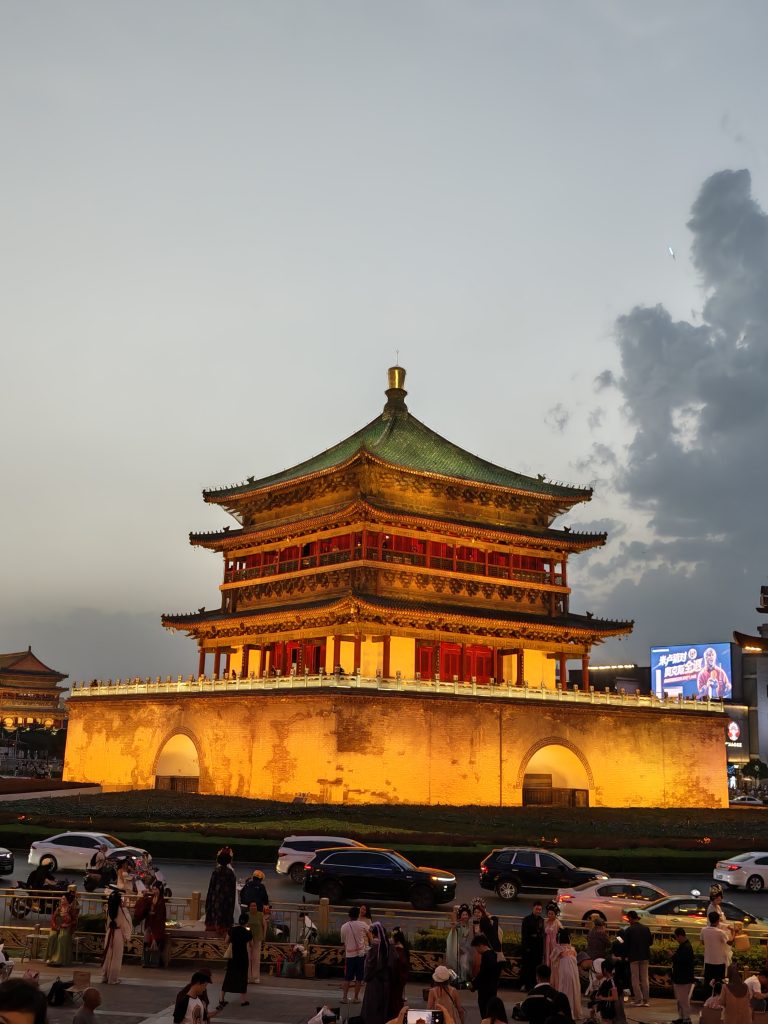
The Bell Tower (钟楼, Zhonglou) stands at the heart of the historic walled city. Four major roads radiate from the central area, leading north, south, east, and west.
From here, it’s easy to walk to the Drum Tower, the Muslim Quarter, and plenty of traditional snack shops.
How convenient is the Bell Tower for sightseeing?
The nearest major metro station is Zhonglou Station (钟楼站), served by Lines 2 and 6.
Line 2 is particularly helpful for international visitors. It connects Xi’an North Railway Station, the Bell Tower, Yongning Gate, and Xiaozhai, where you can head toward the Shaanxi History Museum.
| Destination | Best transport | Approximate travel time |
|---|---|---|
| Drum Tower | Walk | 5–10 minutes |
| Muslim Quarter entrance | Walk | 5–15 minutes |
| Yongning Gate / City Wall | Walk or Metro Line 2 | 10–25 minutes |
| Shaanxi History Museum | Metro and walk | 25–40 minutes |
| Giant Wild Goose Pagoda | Metro with transfer | 30–45 minutes |
| Xi’an North Railway Station | Direct Metro Line 2 | 25–35 minutes |
These are general estimates, not live journey times. Your hotel’s exact location, walking distance to the metro entrance, and train waiting times will all make a difference.
The Bell Tower isn’t the closest area to every attraction. It’s simply one of the most balanced places to stay.
That’s particularly valuable when you only have two or three days.
What can you do around the Bell Tower at night?

This is one of my favorite reasons to stay here.
After a day exploring the Terracotta Army or the City Wall, you won’t need another long journey to find dinner.
Just walk out of your hotel and head toward the Muslim Quarter for local specialties such as beef or lamb paomo, roujiamo, liangpi, and grilled lamb skewers.
For photography, the Bell Tower and Drum Tower are particularly beautiful after their lights come on.
If you want to explore beyond the busiest tourist streets, wander into Dapiyuan (大皮院) or Xiyangshi (西羊市). These streets still offer glimpses of everyday neighborhood life alongside the restaurants and visitor crowds.
What are the disadvantages of staying near the Bell Tower?
Noise is the biggest concern.
This is one of Xi’an’s busiest commercial and sightseeing districts. Depending on your room, you may hear traffic, late-night pedestrians, music, or activity from nearby businesses.
I wouldn’t automatically pay more for a “Bell Tower View Room.”
If you’re a light sleeper, check whether your room faces a main road, whether the windows are soundproof, and whether the hotel can offer a quieter room away from the street.
Some older buildings in the city center can also have smaller rooms or less modern facilities than their photographs suggest.
My local recommendation: Choose a reputable hotel within a 5–10-minute walk of Zhonglou Station. You don’t need to stay directly opposite the Bell Tower. A hotel one or two streets away may offer a better balance of price, comfort, and quiet.
3. Yongning Gate: Historic Atmosphere with Convenient Transport

If you want easy access to Xi’an’s old city without staying right in the busiest part of the Bell Tower district, Yongning Gate is an excellent alternative.
Yongning Gate (永宁门), also known as the South Gate, is one of the most important entrances to Xi’an’s ancient City Wall.
It’s also one of my preferred starting points for visiting the wall itself.
Hotels are spread across both the inner and outer sides of the wall, giving you a good range of accommodation choices.
Who should stay near Yongning Gate?
I’d particularly recommend it to three kinds of travelers.
History and photography lovers: Staying near the South Gate lets you enjoy the historic walls in the early morning or evening, when the ancient architecture looks especially striking against the modern city.
Travelers who value convenient public transport: Yongningmen Station is on Metro Line 2, just one stop south of Zhonglou. You can also travel directly toward Xi’an North Railway Station on the same line.
Couples and slower-paced travelers: Around the South Gate, you’ll find historic streets, restaurants, cafés, and modern shopping areas. A walk near the City Wall after dinner can be a lovely way to spend an evening.
What attractions are nearby?

The obvious highlight is Xi’an City Wall (西安城墙).
The wall’s full circuit is approximately 13.7 kilometers (8.5 miles), but you certainly don’t need to cover all of it.
If you have two hours, walking a shorter section around the South Gate is a rewarding experience. Bicycle rentals are also available according to the site’s operating rules.
Other worthwhile places nearby include Shuyuanmen Cultural Street (书院门) and the Forest of Stone Steles Museum (西安碑林博物馆).

Shuyuanmen is especially interesting if you’re curious about Chinese writing and traditional art.
You’ll find shops selling calligraphy brushes, paintings, ink, seals, and other cultural items.
It’s an enjoyable place to wander slowly, even if you don’t understand Chinese characters.
Is Yongning Gate quieter than the Bell Tower?
Not necessarily.
This is a detail that many accommodation guides overlook.
Although Yongning Gate is outside the busiest part of the Bell Tower shopping district, the streets around the South Gate also carry significant traffic and tourist activity.
Hotels facing Nanguan Main Street, South Street, or busy squares may still experience noise.
What matters most isn’t simply the neighborhood name. It’s the hotel’s exact street, building, floor, and room orientation.
I’d look for a hotel near the metro station but away from the busiest traffic lanes, particularly if you’re sensitive to noise.
If you want a City Wall view, make sure the specific room category includes it. Not every room in a “City Wall hotel” necessarily overlooks the wall.
4. Giant Wild Goose Pagoda: Best for Families and Tang-Style Nightlife

The Giant Wild Goose Pagoda area is ideal for travelers who enjoy cultural attractions, evening entertainment, shopping centers, and modern hotels.
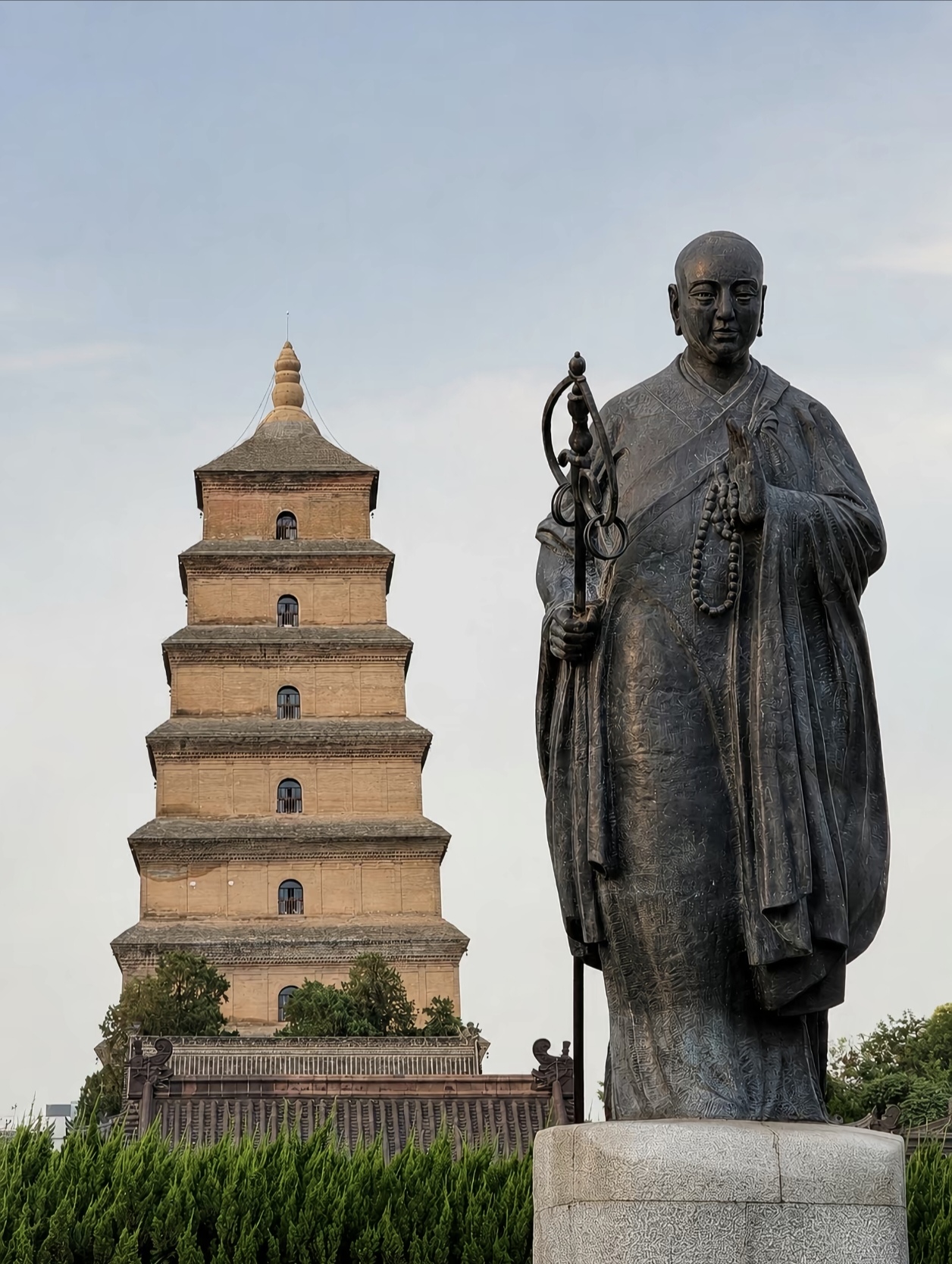
The Giant Wild Goose Pagoda (大雁塔) stands in southern Xi’an and is one of the city’s most important Tang-dynasty Buddhist landmarks.
The surrounding area includes Daci’en Temple, Datang Everbright City, shopping complexes, restaurants, and modern cultural attractions.
Compared with the Bell Tower and Yongning Gate, this neighborhood has a more contemporary cultural-tourism atmosphere.
What can you see and do here?
First, there’s the Giant Wild Goose Pagoda itself.
The pagoda is closely associated with Xuanzang, the Buddhist monk who traveled to India to collect scriptures and later worked on translating them into Chinese.
If you’ve heard of the Chinese classic Journey to the West, you’ll find the historical connection particularly interesting.
Then there’s Datang Everbright City (大唐不夜城), also known as the Great Tang All Day Mall.

This large Tang-inspired pedestrian district comes alive after dark with lighting, shops, public art, and cultural performances.
If your hotel is within walking distance, you can enjoy the atmosphere in the evening and return without crossing the city late at night.
The area also has plenty of shopping malls and modern restaurants.
For families with children, or visitors who prefer spacious modern commercial areas to the narrow, crowded lanes of the old city, this can be an appealing choice.
Is the Giant Wild Goose Pagoda area convenient for transport?
The main nearby station is Dayanta Station (大雁塔站), served by Metro Lines 3 and 4.
Line 4 connects with major transport hubs including Xi’an North Railway Station and Xi’an Railway Station.
However, the pagoda district is not in the historic city center.
If your days are mainly focused on the Bell Tower, Muslim Quarter, and South Gate, you’ll need metro rides or taxis to reach those places.
For a two-day trip, I generally wouldn’t choose this as my first option.
Is it noisy near Datang Everbright City?
It can be, particularly on weekends and Chinese public holidays.
Hotels directly beside pedestrian streets, plazas, and performance areas may hear evening crowds or music.
There’s another detail worth checking: “Near Giant Wild Goose Pagoda” doesn’t necessarily mean “two minutes from Datang Everbright City.”
A hotel may be close to Dayanta Metro Station but still require a 15-minute walk or longer to reach the part of Datang Everbright City you want to explore.
Before booking, check both distances separately: the hotel to the metro station, and the hotel to your intended evening sightseeing area.
5. How Much Do Hotels in Xi’an Cost?
Xi’an has accommodation for a wide range of budgets, from simple local chain hotels to luxury international properties.
But prices aren’t fixed. Weekends, school holidays, major Chinese public holidays, and popular travel seasons can make a big difference.
Here are general estimates for a standard double or twin room on ordinary travel dates, not live booking prices.
| Area | Budget hotel | Midrange hotel | Upscale hotel |
|---|---|---|---|
| Bell Tower | ¥180–300/night | ¥300–550/night | ¥600+ |
| Yongning Gate | ¥180–320/night | ¥300–550/night | ¥600+ |
| Giant Wild Goose Pagoda | ¥200–350/night | ¥350–650/night | ¥700+ |
These ranges overlap. It doesn’t mean that every hotel in one district is more expensive than every hotel in another.
A hotel that costs ¥250 on an ordinary weekday might charge significantly more during China’s National Day holiday.
Rooms with a view of famous landmarks can also command a premium.
Can you find a decent hotel for around ¥200 a night?
Yes, but choose carefully.
At that budget, you may find a perfectly reasonable economy chain hotel in Xi’an.
However, if you want a larger room, good soundproofing, reliable facilities, and staff who can assist international guests, you’ll need to compare the reviews closely.
If your budget allows, I’d suggest looking first at reputable hotels around ¥300–500 per night for your first visit to China.
That price range gives you more options without pushing you into luxury-hotel territory.
A higher price doesn’t automatically guarantee a better stay, though. Location, cleanliness, and recent reviews still matter more than impressive lobby photographs.
Is a cheaper hotel always better value?
Not necessarily.
Imagine you’re comparing two hotels:
Hotel A costs ¥200 per night but is far from the nearest metro station, so you regularly need a taxi.
Hotel B costs ¥280 per night and is a five-minute walk from the metro, with plenty of restaurants nearby.
Over three nights, Hotel B costs ¥240 more.
But you might save money on transport, avoid unnecessary walking with luggage, and spend less of your holiday getting around.
For a short trip to Xi’an, a convenient hotel can easily be better value than a cheaper one in an inconvenient location.
6. Getting to Your Xi’an Hotel from the Airport or Railway Station

Two major transport hubs are especially important for international visitors:
Xi’an Xianyang International Airport (XIY) and Xi’an North Railway Station (西安北站).
From Xi’an Xianyang International Airport
The airport is northwest of central Xi’an.
For hotels around the Bell Tower or Yongning Gate, a practical public-transport route is:
Airport → Metro Line 14 → Xi’an North Railway Station → Metro Line 2 → Zhonglou or Yongningmen
Allow roughly 70–90 minutes or more, depending on the terminal, connections, and the walk to your hotel.
You can use around ¥8–10 as an initial metro-fare estimate, but check the current fare before traveling.
For a hotel near the Giant Wild Goose Pagoda, transfer to Metro Line 4 at Xi’an North Railway Station and continue to Dayanta Station.
Make sure you choose the correct airport metro station:
-
Terminals T1, T2, and T3: Airport West (机场西).
-
Terminal T5: Airport (T5) (机场T5).
Both are served by Metro Line 14.
If you arrive late at night, have several suitcases, or are traveling with young children or older relatives, a licensed taxi or DiDi may be more comfortable.
For a trip to the Bell Tower area, ¥100–180 is a preliminary car-fare allowance, not a guaranteed quote. The actual fare will depend on traffic, pickup location, and vehicle type.
Avoid accepting unsolicited rides from people approaching you inside or just outside the airport.
From Xi’an North Railway Station
If you’re traveling to Xi’an by high-speed train from Beijing, Shanghai, Chengdu, or another Chinese city, you may arrive at Xi’an North (西安北站).
From there:
-
Bell Tower: Take Metro Line 2 directly to Zhonglou.
-
Yongning Gate: Take Metro Line 2 directly to Yongningmen.
-
Giant Wild Goose Pagoda: Take Metro Line 4 directly to Dayanta.
All three accommodation areas are connected by metro.
One important reminder: Xi’an Railway Station (西安站) and Xi’an North Railway Station (西安北站) are different stations.
Double-check your arrival station before arranging your hotel transfer.

4 Comments