What to Eat in Xi’an: 12 Must-Try Local Foods, Best Places to Eat & Insider Tips

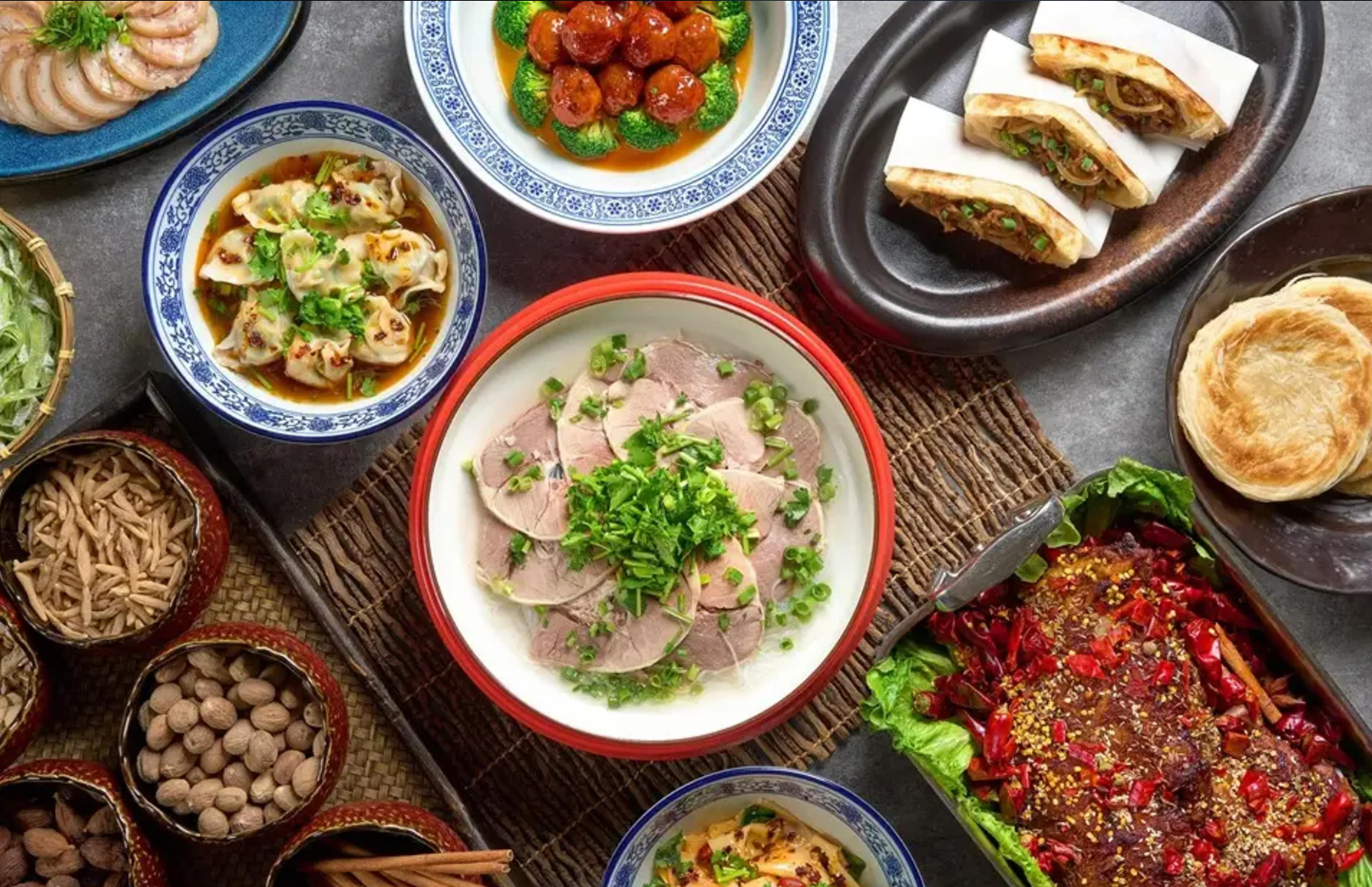
If you’re visiting Xi’an for the first time, some of the best foods to try are roujiamo (Chinese-style meat sandwiches), beef or lamb paomo, liangpi (cold noodles), biangbiang noodles, sour soup dumplings, and zenggao (sticky rice cake).
If you only have two or three days in the city, I recommend exploring the areas around the Bell and Drum Towers, the quieter streets of the Muslim Quarter, particularly Dapiyuan and Sajinqiao, and the local restaurants near the Giant Wild Goose Pagoda.
These neighborhoods offer a wonderful introduction to the distinctive flavors of Xi’an and Shaanxi Province.
But as someone familiar with local life in China, there’s something I want you to know: Xi’an’s food scene goes far beyond the handful of famous snacks you’ll see in travel brochures.
In this historic city, food is woven into everyday life. Many locals begin their mornings with a steaming bowl of spicy meatball soup, grab a generous serving of noodles for lunch, and spend their evenings enjoying grilled meat skewers with friends.
Xi’an’s cuisine is also quite different from what you’ll find in southern China. While rice is a staple in much of the south, people in Xi’an have a particular love for wheat-based foods, including noodles, flatbreads, and dumplings.
The city is also home to a historic Hui Muslim community, whose halal food traditions, beef and lamb dishes, and aromatic spices have helped shape the local food culture.
So, if you want to discover Xi’an through its food, here are 12 local specialties I’d recommend trying on your first visit.
1. The 12 Best Local Foods to Try in Xi’an
1. Roujiamo (肉夹馍) — Xi’an’s Famous Chinese-Style Meat Sandwich

Traditional roujiamo: slow-braised meat tucked inside a freshly baked flatbread.
Typical price: ¥10–20 each
If you only have time to try one street food in Xi’an, make it roujiamo.
Foreign visitors often call it a “Chinese hamburger,” but don’t expect anything like a typical American burger.
Traditional Shaanxi-style roujiamo, known as lazhi roujiamo, is usually made with pork that has been slowly braised until tender. The meat is finely chopped and stuffed into a freshly baked wheat flatbread called baiji mo.
A really good roujiamo has a slightly crispy, fragrant exterior and soft, juicy meat inside. It’s simple, filling, and incredibly satisfying.
My local tip: Order the version with a mixture of lean and fatty meat. The all-lean option can be a little dry, while the combination gives the filling a richer flavor.
One important thing to know is that not every roujiamo contains the same type of meat.
At ordinary Shaanxi-style shops, the traditional filling is generally pork. However, around the Muslim Quarter, you’ll also find halal versions made with beef or lamb.
If you don’t eat pork, always check the filling before ordering.
Where to try it: Ziwulu Zhangji Roujiamo (子午路张记肉夹馍)
- Address: No. 227 Cuihua Road, Yanta District, Xi’an (西安市雁塔区翠华路227号).
- Nearby attraction: Shaanxi History Museum.
- Also worth trying: Freshly cooked meatball soup (生汆丸子汤).
This is a convenient place to eat if you’re visiting the museum.
For a classic Xi’an street-food meal, pair your roujiamo with a plate of liangpi and a bottle of Bingfeng (冰峰), Xi’an’s beloved local orange soda.
It’s a combination locals have enjoyed for years.
2. Beef or Lamb Paomo (牛羊肉泡馍) — A Traditional Xi’an Dining Experience

Paomo combines hand-torn flatbread, tender beef or lamb, and aromatic broth.
Typical price: ¥25–50 per bowl
Paomo is one of the dishes that best represents Xi’an’s traditional food culture.
It’s made with pieces of dense wheat flatbread, beef or lamb, and a rich, flavorful broth. Some versions also contain glass noodles.
But here’s something that might surprise you on your first visit.
You place your order, and the server brings you two pieces of bread and an empty bowl.
You might wonder, “Where’s my food?”
Don’t worry. That’s part of the experience.
At many traditional paomo restaurants, customers tear the bread into tiny pieces themselves before the kitchen prepares the dish.
Ideally, each piece should be about the size of a soybean.
Once you’re finished, you hand the bowl back to the staff, and the kitchen cooks the bread with broth, meat, and other ingredients according to the restaurant’s method.
When the bowl returns to your table, the bread has absorbed the flavorful broth while retaining a pleasantly chewy texture.
It’s hearty, comforting, and unlike most soups you’ve probably had before.
My local tip: Start with a regular beef paomo rather than the most expensive premium set. Beef paomo is a common local choice, although lamb is another excellent option if you prefer it.
Many restaurants also serve tang suan (糖蒜), or sweet pickled garlic.
It has a sweet-and-sour flavor that helps balance the richness of the meat. Try a little alongside your soup rather than adding too much at once.
Where to try it: Tongshengxiang (同盛祥)
Tongshengxiang is one of Xi’an’s long-established names for beef and lamb paomo.
- Suggested location: Datang Everbright City area, around No. 518 Yanta South Road, Yanta District.
- Best combined with: An evening visit to Datang Everbright City (大唐不夜城).
If you’re planning to explore the illuminated streets and Tang Dynasty-inspired architecture at night, this is a convenient area to enjoy a traditional paomo dinner.
3. Liangpi (凉皮) — Refreshing, Tangy Cold Noodles
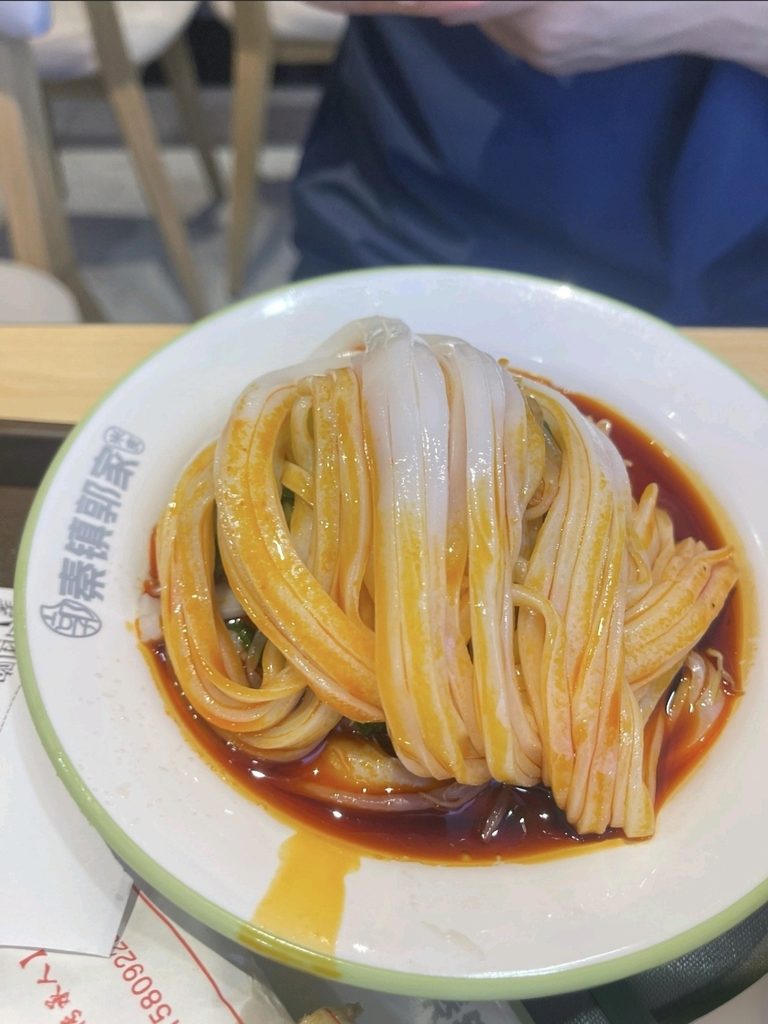
Liangpi is known for its smooth texture and tangy, chili-infused dressing.
Typical price: ¥8–18 per serving
Liangpi might surprise you if you’ve never tried Chinese cold noodles before.
Although its Chinese name contains the character for “skin,” there’s no animal skin involved.
Liangpi is made from starch-based sheets, commonly prepared using wheat or rice. These sheets are sliced into strips and served with a flavorful dressing.
A typical bowl contains vinegar, chili oil, garlic, and shredded cucumber.
The result is smooth, chewy, tangy, and refreshing.
Although it’s usually served cold, locals don’t eat liangpi only during summer. You’ll find people enjoying it even in the middle of winter.
Shaanxi also has several distinctive varieties:
- Qinzhen Mipi (秦镇米皮): Smooth, rice-based noodles.
- Qishan Ganmianpi (岐山擀面皮): Firmer, chewier noodles with a distinctive bite.
- Sesame Paste Liangpi (麻酱酿皮): A richer version with a creamy sesame dressing.
For your first visit, I’d especially recommend Qinzhen rice noodles.
Where to try it: Qinzhen Guojia Mipi (秦镇郭家米皮)
This is one of my personal favorites for authentic Xi’an-style rice noodles.
The business has several locations around the city, so there’s no need to travel across Xi’an just to visit one particular branch.
Find whichever location is most convenient for your itinerary.
4. Biangbiang Noodles (Biangbiang面) — The Famous Belt-Width Noodles

Biangbiang noodles are famous for their extraordinary width and satisfying chewy texture.
Typical price: ¥15–30 per bowl
If you love noodles, biangbiang noodles should be near the top of your Xi’an food list.
Their most striking feature is their width.
Some noodles are several centimeters across, making them look more like long ribbons than ordinary noodles.
That’s why they’re sometimes called “belt noodles.”
To make them, the cook stretches and repeatedly slaps the dough against a work surface, creating broad, elastic strips.
After cooking, the noodles are often topped with chili flakes, garlic, and green onions before sizzling hot oil is poured over them.
The hot oil releases a wonderfully appetizing aroma.
Depending on the restaurant, you may also find toppings such as minced meat, tomatoes, or scrambled eggs.
The noodles are thick, chewy, and incredibly satisfying. Be warned, though: portions can be generous.
There’s also a fun cultural story behind their name.
The character traditionally used to write “biang” is famously complicated, with an unusually large number of strokes.
Even many Chinese people don’t know how to write it from memory.
It’s a fascinating little introduction to the creativity of Chinese characters.
Where to try it: Aihua Belt Noodles (爱骅裤带面 / 爱华裤带面)
Look for this noodle shop when exploring the area around the Bell Tower.
Two dishes to look for on the menu are:
- Youpo Biangbiang Mian (油泼Biangbiang面): Wide noodles topped with seasonings and sizzling hot oil.
- Sanheyi Biangbiang Mian (三合一Biangbiang面): A combination-style bowl, usually featuring several different toppings.
The exact toppings can vary between restaurants, so check the menu before ordering.
5. Qishan Saozi Noodles (岐山臊子面) — Tangy, Spicy Shaanxi Noodles

Qishan saozi noodles are famous for their fragrant, vinegar-rich broth.
Typical price: ¥10–25 per bowl
Many first-time visitors assume that Chinese noodle dishes are fairly similar.
Spend a few days in Shaanxi, though, and you’ll quickly discover how different they can be.
Qishan saozi noodles originated in Qishan County, Shaanxi Province, and have become a popular traditional dish throughout the region.
Unlike the wide, thick biangbiang noodles, this dish usually features relatively thin noodles.
They’re served with a flavorful combination that may include minced pork, tofu, egg, and wood ear mushrooms.
But what makes Qishan noodles special is the broth.
Traditional Qishan flavors emphasize sourness, spiciness, and fragrance, with vinegar playing an especially important role.
If you enjoy tangy food, this dish is absolutely worth trying.
One warning, though: the vinegar flavor can be stronger than you expect.
If you’re not a fan of sour foods, consider trying a smaller portion first.
Where to try it: Yongfeng Qishan Noodles (永丰岐山面)
Look for branches around the Yanta North Road area.
You can also look for traditional Shaanxi noodle restaurants when visiting the Giant Wild Goose Pagoda area.
Dietary note: Traditional Qishan saozi noodles commonly contain pork. Vegetarians and anyone avoiding pork should check the ingredients carefully.
6. Sour Soup Dumplings (酸汤水饺) — A Hidden Gem of Xi’an’s Old Streets

Xi’an-style dumplings served directly in a tangy, spicy broth.
Typical price: ¥15–30 per serving
Xi’an-style sour soup dumplings are quite different from the Chinese dumplings you might already know.
Instead of serving boiled dumplings on a plate with vinegar on the side, this dish places them directly into a tangy, spicy broth.
The soup gets its signature flavor from vinegar, chili oil, and a mixture of seasonings.
As the dumplings sit in the broth, they absorb some of that delicious sour-and-spicy flavor.
In Xi’an’s Muslim Quarter, common fillings include beef and beef with yellow Chinese chives.
The combination of beef and chives gives the dumplings a particularly savory aroma.
Where to try it: Ma’er Sour Soup Dumplings (马二优质酸汤水饺)
- Address: No. 131 Sajinqiao, Lianhu District, Xi’an (西安市莲湖区洒金桥131号).
- Area: Sajinqiao food street, within the wider Muslim Quarter neighborhood.
This is a great lunch stop if you’re planning to explore the older streets of Xi’an.
My local tip: Order a regular bowl first and taste the broth before adding any extra chili oil.
Some shops make their sour soup quite spicy already.
7. Soup-Filled Dumplings (灌汤包) — Delicious, but Watch Out for the Hot Broth

Soup-filled dumplings may look ordinary on the outside, but each one contains hot, savory broth.
Typical price: ¥15–35 per serving
Soup-filled dumplings are one of China’s most enjoyable dumpling experiences.
They’re delicate steamed buns with savory meat filling and hot broth trapped inside.
In Xi’an’s Muslim Quarter, you’ll find versions made with beef or lamb.
They may look like ordinary steamed buns, but the hot soup inside is what makes them special.
If you’ve never eaten soup dumplings before, don’t bite straight into one.
The broth can be extremely hot.
Instead, place a dumpling on your spoon, carefully take a small bite to open it, and let some steam escape.
Then slowly enjoy the broth and filling.
You can also add a little Chinese black vinegar if you like.
Where to try it: Jia San Soup Dumplings (贾三灌汤包子馆)
- Address: No. 93 Beiyuanmen, Lianhu District, Xi’an (西安市莲湖区北院门93号).
- Area: Near the main Muslim Quarter shopping streets.
It’s conveniently located for anyone exploring the Bell and Drum Towers.
For your first order, try the beef soup dumplings with a simple cold vegetable side dish or another local snack.
8. Spicy Meatball Soup (肉丸胡辣汤) — What Locals Eat for Breakfast
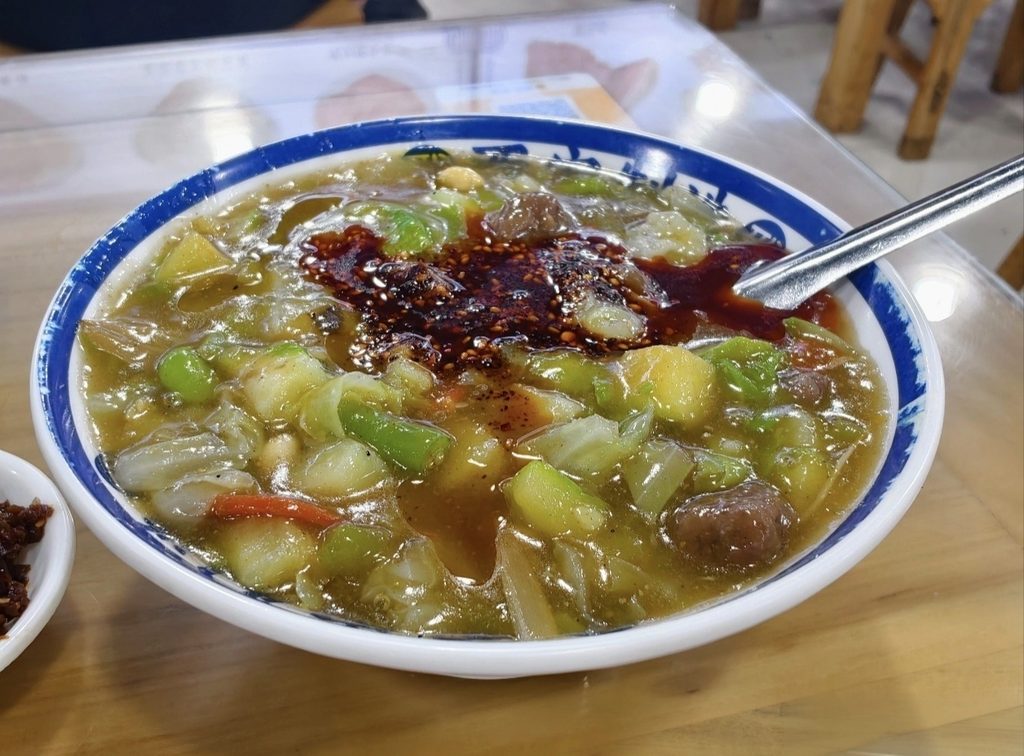
A hearty bowl of Xi’an-style spicy meatball soup, a popular local breakfast.
Typical price: ¥8–18 per bowl
Want to know what people in Xi’an actually eat for breakfast?
Try a bowl of rouwan hulatang, or spicy meatball soup.
Don’t expect a light, clear broth.
Xi’an-style hulatang is usually thick and hearty, with meatballs, potatoes, carrots, cauliflower, and other vegetables.
It’s seasoned with pepper and a mixture of aromatic spices.
Halal versions commonly found in the Muslim Quarter generally use beef meatballs.
Some shops also add chili oil for extra flavor.
Locals often tear pieces of flatbread into the soup, turning it into an even more filling breakfast.
If your usual breakfast is coffee and toast, this might completely change your idea of what breakfast can look like.
Where to try it: Xing Laosan Meatball Hulatang (邢老三肉丸糊辣汤)
This is one of my personal favorites for meatball hulatang in Xi’an.
The shop has been known for its 24-hour service, although you should confirm its current opening hours before visiting.
If you want to experience a genuinely local breakfast, this is exactly the sort of place I’d recommend.
9. Shuipen Yangrou (水盆羊肉) — A Comforting Lamb Soup

Shuipen yangrou is a lighter lamb soup traditionally enjoyed with flatbread.
Typical price: ¥25–45 per serving
At first glance, shuipen yangrou might look similar to lamb paomo.
But the two dishes are quite different.
With traditional paomo, the bread is broken into pieces and cooked with the broth.
With shuipen yangrou, the lamb soup and bread are generally served separately.
The broth is usually lighter and clearer, allowing the natural flavor of the lamb to stand out.
Depending on the restaurant, it may also contain glass noodles, cilantro, or other ingredients.
Locals enjoy sipping the broth, eating the tender lamb, and taking bites of flatbread between mouthfuls.
A popular accompaniment is yueya bing, a crescent-shaped flatbread.
If you find paomo too rich or heavy, shuipen yangrou may suit your taste better.
Where to try it
You can find shuipen yangrou at traditional Shaanxi restaurants and lamb soup shops around Xi’an.
You don’t necessarily need to visit the main tourist streets of the Muslim Quarter.
But here’s my personal opinion: if your trip takes you to Weinan (渭南), another city in Shaanxi Province, try shuipen yangrou there instead.
I actually prefer the flavor of the Weinan version.
Different parts of Shaanxi have their own approaches to this dish, and Weinan is particularly worth exploring for traditional lamb soup.
10. Zenggao (甑糕) — Sweet, Sticky Rice Cake with Red Dates

Zenggao is a traditional sticky rice dessert steamed with dates and beans.
Typical price: ¥5–15 per serving
Zenggao might not win any beauty contests at first glance.
It usually looks like a large pot of dark-colored, sticky rice cake.
But don’t judge it by its appearance.
This traditional Xi’an dessert is made by slowly steaming glutinous rice with ingredients such as red dates and beans.
During the long cooking process, the rice absorbs the natural sweetness of the dates.
The finished dessert is soft, chewy, sticky, and surprisingly filling.
Unlike many Western cakes, traditional zenggao gets much of its sweetness from the dates rather than frosting or a sugary topping.
If you enjoy sticky rice desserts, this is definitely worth a try.
Where to try it: Dongnanya Zenggao (清真东南亚甑糕)
- Location: Near the intersection of Xiyangshi Street and North Guangji Street, around Majia Shizi, Lianhu District.
- Chinese address reference: 西安市莲湖区西羊市街与北广济街交叉口,麻家什字东北角.
This long-established shop is known for its zenggao, which is typically sold as takeaway food.
Try visiting in the morning or before lunchtime.
Popular shops may have queues, and some items can sell out.
My local tip: Start with a small portion. Zenggao is much more filling than it looks.
11. Fried Persimmon Cakes (柿子饼) — A Sweet Xi’an Street Snack

Freshly fried persimmon cakes are a popular traditional sweet in Xi’an.
Typical price: ¥3–10 each
If you visit Xi’an in autumn, you may notice persimmon snacks appearing in markets and food stalls.
That’s partly because Lintong, an area near Xi’an, is famous for its persimmons.
A popular traditional snack is shizi bing, sometimes called shizi huta.
It’s made using persimmon flesh mixed with flour and other ingredients.
Some versions are filled with walnuts, sweet rose-flavored filling, or other additions.
The cakes are then fried until the outside becomes lightly crisp while the inside stays soft and sweet.
Freshly fried persimmon cakes smell wonderful.
But be careful: they can be very hot inside.
Where to find them
Look for stalls around Xiyangshi Street (西羊市), Dapiyuan (大皮院), and Sajinqiao (洒金桥).
Choose a stall that prepares them fresh and clearly displays its prices.
I recommend buying just one at first.
After a day of eating roujiamo, paomo, and noodles, a persimmon cake makes a lovely little dessert.
12. Xi’an Grilled Lamb Skewers (西安烤肉) — The Perfect Evening Street Food

Cumin-seasoned lamb skewers are one of the highlights of Xi’an’s evening food scene.
Typical price: ¥3–12 per skewer; larger specialty skewers may cost more
If you enjoy barbecue, don’t leave Xi’an without trying its grilled meat skewers.
In the Muslim Quarter, beef and lamb skewers are especially popular.
Small pieces of meat are threaded onto skewers, grilled over charcoal or other cooking equipment, and seasoned with cumin, chili, and other spices.
Cumin is one of the defining flavors of Xi’an-style barbecue.
The grilled meat has a wonderfully smoky, aromatic flavor that works perfectly with other local snacks.
It’s particularly enjoyable in the evening, when the streets come alive with people eating, chatting, and exploring.
Where to try it
I recommend exploring the barbecue restaurants around Xiyangshi Street (西羊市) and Sajinqiao (洒金桥) after dark.
One thing first-time visitors sometimes overlook is pricing.
Some shops charge per skewer, while large skewers or specialty barbecue dishes may use different pricing systems.
Don’t order 20 or 30 skewers before checking the price and portion size.
If you don’t like spicy food, ask for your skewers without chili.
2. Where to Eat in Xi’an: Four Food Areas Worth Exploring
Knowing what to eat is only half the experience.
The other half is knowing where to find it.
Xi’an’s best food isn’t limited to one famous tourist street. Different neighborhoods offer different dining experiences.
Here are four areas I’d recommend exploring.
1. The Muslim Quarter and Beiyuanmen — Great for First-Time Visitors

The Muslim Quarter is one of Xi’an’s best-known food destinations.
You’ll find restaurants and stalls selling beef and lamb paomo, soup dumplings, grilled meat, sweets, and all kinds of traditional snacks.
It’s also a fascinating place to experience the food culture of Xi’an’s Hui Muslim community.
In the evening, the streets become especially lively.
However, the main tourist street around Beiyuanmen can be quite commercialized.
My advice: Enjoy the atmosphere on the main street, but explore the smaller lanes when looking for somewhere to eat.
Dapiyuan (大皮院), Xiyangshi (西羊市), and North Guangji Street (北广济街) are all worth checking out.
You’ll find a mix of established eateries, snack shops, and neighborhood businesses.
2. Sajinqiao — A More Local Food Experience

If you want to experience something closer to everyday life in Xi’an, I particularly recommend Sajinqiao.
This area is known for foods such as spicy meatball soup, sour soup dumplings, beef roujiamo, and sticky rice cake.
While it has become popular with visitors, there are still restaurants and breakfast shops serving nearby residents.
Best times to visit: 7:00–10:00 a.m. or in the evening.
Come in the morning to see locals stopping for breakfast before work.
In the evening, you can enjoy grilled meat skewers, hot soups, and a livelier street-food atmosphere.
Getting there: Take Xi’an Metro Line 1 to Sajinqiao Station (洒金桥站).
3. Bell Tower, Beilin, and South Gate — Best for Traditional Shaanxi Noodles

If your main goal is to try biangbiang noodles, hot-oil noodles, or Qishan saozi noodles, explore the streets south of the Bell Tower and around Beilin and the South Gate.
You’ll find plenty of everyday noodle restaurants in this part of the city.
It’s also a convenient area for sightseeing.
Rather than traveling across Xi’an just to visit a restaurant that went viral online, I’d recommend finding a well-established noodle shop close to the attractions you’re already visiting.
Sometimes the most enjoyable meals are the ones you discover without planning too much.
4. Giant Wild Goose Pagoda and Cuihua Road — Food and Sightseeing Together

If your itinerary includes the Shaanxi History Museum, Giant Wild Goose Pagoda, and Datang Everbright City, this area is a practical place to plan a meal.
For example, you could try roujiamo at Ziwulu Zhangji on Cuihua Road or look for a traditional paomo restaurant near Datang Everbright City.
For first-time international visitors, combining restaurants with nearby attractions makes exploring Xi’an much easier.
There’s no reason to cross the city several times a day just to eat.