How to Visit the Forbidden City in Beijing: Tickets, Passport Booking, Opening Hours & Walking Route

Visiting Beijing’s Forbidden City for the first time? Book your Palace Museum ticket seven days ahead, bring the original passport used for your reservation, enter through the Meridian Gate on the south side, and explore the imperial complex from south to north. Allow around 3–4 hours for the main halls, or 5–6 hours if you want to visit the Treasure Gallery, Gallery of Clocks, and additional exhibitions.
The Forbidden City, known in Chinese as Zijincheng (紫禁城) and now managed as the Palace Museum (故宫博物院), is one of Beijing’s most extraordinary landmarks. For centuries, it was the political and ceremonial heart of imperial China, serving the emperors of the Ming and Qing dynasties.
But if you’re coming to China for the first time and don’t speak Mandarin, a few things can seem surprisingly complicated. Can you buy tickets with a foreign passport? Exactly when do reservations open? Where is the entrance? And with so many courtyards and palaces, what should you actually see?
As someone familiar with traveling around China, I recommend sorting out your ticket and entry route before you arrive. This guide explains the process, from booking and transport to a realistic walking route and the mistakes to avoid.
1. Is Beijing’s Forbidden City Worth Visiting? How Much Time Do You Need?
Yes. If it’s your first trip to Beijing, I would reserve at least half a day for the Forbidden City.
The imperial palace complex was completed in 1420, during the Ming dynasty, and later served the Qing emperors. Today it is both a remarkable collection of historic buildings and a museum housing an enormous range of Chinese art and imperial artifacts.
The palace was inscribed on the UNESCO World Heritage List in 1987 as part of the Imperial Palaces of the Ming and Qing Dynasties.
Inside, you’ll see towering red walls, golden glazed-tile roofs, broad ceremonial courtyards, carved stone terraces, and buildings laid out along a carefully planned central axis. The scale of the place reveals a great deal about how imperial authority and court ritual shaped Chinese architecture.
But the Forbidden City is huge. Three to four hours is reasonable for first-time visitors following the main route without lengthy museum stops. If you enjoy history, photography, or detailed exhibitions, set aside five to six hours or more.
My local tip: Don’t treat this like a quick one-hour photo stop. The pleasure comes from walking through the courtyards and gradually seeing how the imperial palace was organized.
2. How to Book Forbidden City Tickets with a Foreign Passport
Foreign visitors can book using a valid passport. You do not need a Chinese national identity card. The Palace Museum requires real-name reservations and does not sell same-day admission tickets.
How much does admission cost?
| Ticket | Adult price |
|---|---|
| High season, April 1–October 31 | ¥60 |
| Low season, November 1–March 31 | ¥40 |
| Treasure Gallery, optional | +¥10 |
| Gallery of Clocks, optional | +¥10 |
For example, an adult visiting in the high season and purchasing both optional galleries would pay ¥80 in admission charges. Discounts and free-entry policies have specific age, identity, and eligibility requirements; don’t assume every foreign student or child qualifies automatically.
Where should you book?
Use the official Palace Museum website, not a stranger offering “guaranteed tickets” on social media:
- Official Palace Museum website in English
- Official English ticket-booking link (linked from the museum’s own English website)
- Official visitor information and opening hours
The official 故宫博物院 WeChat mini-program is another recognized reservation channel, though its interface may be less convenient if you don’t read Chinese.
Step-by-step passport booking
- Open the museum’s official English website and select Tickets / Book Tickets.
- Register or sign in if prompted by the current system.
- Select your visit date, entry session, and ticket type.
- Enter each visitor’s legal name and passport number, following the exact format required on the page.
- Complete payment using a method supported by the official booking interface.
- Save the confirmation and bring the original passport used to make the reservation on the day of your visit.
Every member of your group needs a reservation connected to their own valid identity document. At the entrance, follow the staff’s instructions if you need manual passport verification.
If online payment fails, check the official instructions or contact museum support. Do not assume you can simply turn up and buy a same-day ticket at the gate.
If you’re still getting used to Alipay, WeChat Pay, or using international cards in China, our guide to paying in China as a tourist explains the basics before your trip.
3. When Do Forbidden City Tickets Go on Sale? Opening Hours Explained
Tickets are released seven days before the visit, at 8:00 p.m. Beijing time (UTC+8). This is one of the most useful details to put in your calendar.
For example, if you plan to visit on November 5, the seven-day booking window normally opens at 8:00 p.m. Beijing time on October 29. If you’re booking from Europe or North America, convert that time to your own time zone.
Popular days can fill up quickly, especially around Chinese public holidays. Once your Beijing itinerary is settled, I’d treat this reservation as a priority.
Palace Museum opening hours
| Season | Opens | Last entry | Closes |
|---|---|---|---|
| April 1–October 31 | 8:30 a.m. | 4:00 p.m. | 5:00 p.m. |
| November 1–March 31 | 8:30 a.m. | 3:30 p.m. | 4:30 p.m. |
The museum is normally closed on Mondays, except for specified public-holiday arrangements. Special closures may also be announced separately.
Reservations have morning and afternoon sessions. Under the museum’s published rules, morning reservations must be checked in no later than noon, while afternoon reservations cannot be checked in before 11:00 a.m. Follow the exact timing and instructions shown on your booking.
My recommendation: Choose a morning session and arrive early if you want enough time for the central route and optional galleries.
Always check the official Palace Museum notices shortly before your visit. Exhibition availability, access paths, and individual halls can change during restoration work.
4. How to Get to the Forbidden City—and Which Gate to Use

The normal visitor entrance is the Meridian Gate (午门, Wumen) on the south side. You cannot start a regular museum visit through the northern Gate of Divine Prowess.
The Palace Museum generally operates a south-to-north, one-way visitor route:
- Entrance: Meridian Gate / Wumen (午门), south side.
- Exits: Gate of Divine Prowess / Shenwumen (神武门), north side, or East Prosperity Gate / Donghuamen (东华门), east side.
Save 故宫午门 in your navigation app rather than relying on a vague search for “Forbidden City.” Being sent to the wrong side of such a large complex could cost a lot of walking time.
Getting there by subway
Beijing Subway Line 1 serves Tian’anmen East and Tian’anmen West stations. Depending on access arrangements on the day, you can continue on foot toward the Meridian Gate through the approved pedestrian routes.
Security and crowd-control arrangements around Tian’anmen can affect the way you approach the palace. If you’re visiting only the Palace Museum, follow the museum’s official advice to reach the Meridian Gate via the east or west Tongzi River roads (东、西筒子河路) where directed.
A reservation to enter Tian’anmen Square is a separate matter; a Forbidden City ticket isn’t the same as a Tian’anmen Square reservation.
If you’re new to Chinese navigation, our Amap, Apple Maps, and Google Maps guide for China explains why saving Chinese place names and checking entrances is so useful.
Can a DiDi or taxi take you straight to the gate?
Not necessarily. Traffic controls and pedestrian-only areas near the palace mean a vehicle may have to drop you some distance from the entrance.
If taking a taxi or ride-hailing car, confirm a legal drop-off location and be prepared for a walk. For most first-time visitors staying near a subway line, I would favor the metro and the marked pedestrian approach.
5. The Best First-Time Forbidden City Walking Route
For a first visit, follow the central axis from south to north. This gives you a clear understanding of the palace’s architecture and ceremonial layout without making you zigzag through dozens of side halls.
Suggested route: Meridian Gate → Square at the Gate of Supreme Harmony → Hall of Supreme Harmony → Hall of Central Harmony → Hall of Preserving Harmony → Palace of Heavenly Purity → Hall of Union → Palace of Earthly Tranquility → Imperial Garden → Gate of Divine Prowess.
This is an orientation route, not a guarantee that every building or doorway will be open. Follow the museum’s on-site signs and temporary diversions.
Stop 1: Meridian Gate (午门) — Your Entry to the Imperial Palace
The Meridian Gate is the grand southern entrance of the Forbidden City. Its high red walls and sweeping tiled roofs are an impressive introduction to the scale of the complex.
After entering, take a moment to look at the formal courtyards, waterways, stone bridges, and the way the buildings line up along the central axis.
It’s worth pausing before rushing toward the next hall.
Stop 2: Hall of Supreme Harmony (太和殿) — The Imperial Showpiece

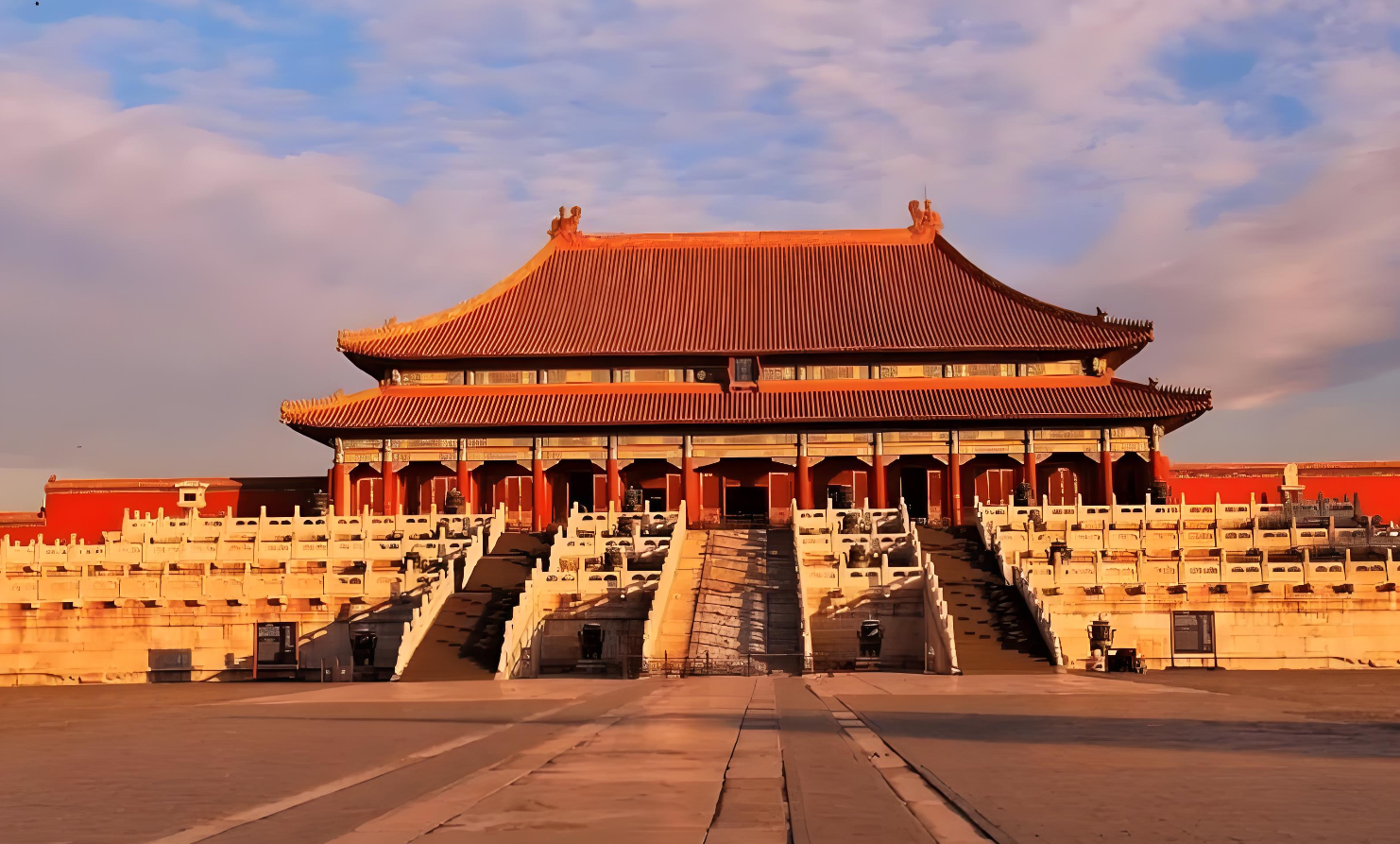
The Hall of Supreme Harmony is one of the most recognizable buildings in the Forbidden City. Set on a monumental white-marble terrace, it was used for important imperial ceremonies, including enthronements and other major state occasions.
If you only have time to look closely at one hall, this is the one I’d choose. The broad courtyard, grand staircase, red columns, and yellow roofs give you an immediate sense of how ceremonial power was expressed through architecture.
Current access reminder: The museum announced construction at the nearby Gate of Supreme Harmony (太和门) beginning August 3, 2026. Some routes or views around the gate may be affected. Don’t cross barriers or assume an older travel map shows today’s exact walking path.
Stop 3: Hall of Central Harmony and Hall of Preserving Harmony (中和殿、保和殿)

Continue north to the Hall of Central Harmony, associated with preparations before important imperial ceremonies, and the Hall of Preserving Harmony, which hosted court functions and, in the Qing period, the final stage of the imperial civil service examinations.
Think of the three great outer-court halls as one architectural sequence. Seeing how they are arranged helps make sense of the hierarchy and ritual order of imperial government.
Stop 4: Palace of Heavenly Purity, Hall of Union and Palace of Earthly Tranquility (乾清宫、交泰殿、坤宁宫)

Farther north, the atmosphere gradually changes as you enter the Inner Court, the part of the palace connected more closely with imperial residence and household life.
The Palace of Heavenly Purity served as an imperial residence during the Ming dynasty and the early Qing period, later taking on important administrative and ceremonial functions.
The Hall of Union stands between it and the Palace of Earthly Tranquility. The latter had different uses over time, including functions related to imperial marriage ceremonies and religious rituals.
These buildings help you imagine a more personal side of palace life behind the monumental public courtyards.
Stop 5: Imperial Garden (御花园) — A Quieter Finish

The Imperial Garden occupies a more intimate space toward the northern end of the central route, with old trees, decorative rocks, pavilions, and ornamental architecture.
After the expansive outer courtyards, it offers a lovely change of scale. Take your time to appreciate the roof details and traditional garden layout before heading for the exit.
Stop 6: Gate of Divine Prowess (神武门) — The Northern Exit

Continue north from the garden to the Gate of Divine Prowess, one of the palace’s principal visitor exits.
My local tip: If you’re following a half-day itinerary, this straightforward south-to-north walk is enough. You don’t need to chase every side courtyard on your first visit.
6. Have a Full Day? Add the Treasure Gallery and Gallery of Clocks
If imperial craftsmanship and decorative arts interest you, the east-side galleries are worth considering. Allow additional walking time and check whether the galleries are open on the date you book.
Treasure Gallery (珍宝馆)
Located in the Palace of Tranquil Longevity (宁寿宫) area, the Treasure Gallery showcases aspects of the imperial art collection and elaborately decorated palace architecture.
It’s a rewarding addition for visitors interested in Chinese jade, fine craftsmanship, and objects associated with the imperial court. Standard adult admission is an additional ¥10.
Gallery of Clocks (钟表馆)

The Gallery of Clocks displays extraordinary historic timepieces and mechanical craftsmanship, revealing a fascinating side of exchange between the Qing imperial court and wider global traditions of horology.
The regular adult supplement is ¥10. If you enjoy intricate mechanisms and unusual museum collections, it’s an excellent optional stop.
Other exhibitions and current closures
The museum also hosts rotating exhibitions on painting, calligraphy, ceramics, and imperial life. Some require separate bookings, and not every historic hall is open year-round.
Important update for late 2026: The Hall of Martial Valor (武英殿, Wuying Dian) closed to visitors on October 19, 2026 for architectural restoration, collection care, and exhibition upgrades. Don’t plan a visit around that hall until the museum announces its reopening.
Because special exhibitions and restoration schedules change, I wouldn’t promise that a particular gallery will be open just because it appears in an older travel guide.
7. What to Do After the Forbidden City: Jingshan Park and Old Beijing

If you still have energy after exiting through Shenwumen, I strongly recommend Jingshan Park (景山公园).
Jingshan sits directly north of the Forbidden City, across the road from the palace’s northern gate. A short uphill climb takes you toward Wanchun Pavilion (万春亭), a famous viewpoint over the Forbidden City’s golden roofs and central-axis layout.
Inside the museum, you appreciate the details of individual halls. From Jingshan, you can finally understand the scale of the entire palace complex from above.
The park requires its own admission ticket, and the climb may be tiring after several hours of walking. If you’re exhausted, skipping it is perfectly reasonable.
If you prefer neighborhood life after imperial architecture, you could explore the Drum Tower, Shichahai, or nearby hutongs on another afternoon. Our half-day Beijing hutong walking tour covers Nanluoguxiang, Mao’er Hutong, Yandai Xiejie, and Houhai, with traditional food stops along the way.
8. Six Mistakes to Avoid at the Forbidden City
1. Arriving without a reservation
The Palace Museum doesn’t sell standard same-day admission. If you turn up without a valid booking, being outside the Meridian Gate does not guarantee you’ll be admitted.
Book through the official system during the advance-sale window.
2. Going to the northern gate to enter
The Gate of Divine Prowess is a visitor exit, not the standard entry point. Go to the Meridian Gate on the south side instead.
Getting this wrong can mean a long detour around the palace walls.
3. Forgetting your original passport
If your booking is under a passport, bring the original document used for the booking. A photo stored on your phone isn’t a reliable replacement for official identity checks.
If the document has been lost or replaced, contact the museum before you go.
4. Paying strangers for supposedly guaranteed entry
The museum says it hasn’t authorized third parties or individuals to act as ordinary ticket agents. Be cautious of inflated-price offers claiming you can enter without advance booking.
Don’t hand over passport information or money to unverified online sellers.
5. Hiring a guide without confirming the fee
An English-speaking guide or audio guide can greatly improve your understanding of the palace, but check the language, total price, duration, and coverage before agreeing to anything.
If you prefer to save money, prepare with English-language history resources and the museum’s official visitor map.
6. Trying to visit several huge attractions in one day
I wouldn’t combine a full Forbidden City visit with an ambitious afternoon trip to the Summer Palace or the Great Wall.
The museum alone involves a lot of walking. Combining the Forbidden City with Jingshan Park is usually far more manageable for first-time visitors.
9. How Much Does a Forbidden City Visit Cost?
If you book directly through the official channel and use Beijing’s subway, the basic sightseeing cost can be surprisingly reasonable.
| Expense | Budget per person |
|---|---|
| Palace Museum standard ticket | ¥40–60, depending on season |
| Treasure Gallery, optional | ¥10 |
| Gallery of Clocks, optional | ¥10 |
| Subway | Depends on your actual route |
| Drinks and a simple meal | Around ¥20–60 |
| English guide or audio guide | Depends on the service |
| Jingshan Park | Separate ticket |
If you only visit the major palace buildings, your essential expenses are the main admission ticket, transport, and any personal food or drink.
Bring water and wear comfortable walking shoes. The courtyards can be hot in summer, and you’ll spend considerable time outdoors between buildings. There are some facilities on site, but I wouldn’t rely on finding a full meal exactly when you want one.
10. Your Forbidden City Checklist Before Leaving the Hotel
The night before your visit, check the following:
- Ticket: Confirmed for the right date and session—not just an attempted payment.
- Passport: The original passport used for your reservation is in your bag.
- Opening day: You’re not planning for an ordinary Monday closure or an announced special closure.
- Entrance: Your map destination is 故宫午门 (Meridian Gate), not the north exit.
- Route: You know the approved approach through the Tian’anmen area and any separate square-entry requirements.
- Phone: Charged, with your ticket confirmation and navigation app ready.
- Comfort: Water, good walking shoes, and suitable sun or rain protection.
- Exhibitions: Check official notices for restoration work and any extra gallery reservations.
If you rely on your phone for directions, payment, and ticket confirmations, it’s worth reading our guide to getting internet access in China before your trip. A working connection and a few saved offline details can make the day much easier.
Need help from the museum? The Palace Museum’s published visitor-service telephone number is 400-950-1925 (when calling internationally, check the operator’s dialing instructions). The museum publishes an English-language website and contact information; confirm the current phone-service hours before calling.
Final Thoughts: Take Your Time in the Forbidden City
The Forbidden City is one of the most worthwhile places to visit on a first trip to Beijing, but its value goes far beyond photographs of red walls and golden rooftops.
The arrangement of its halls, the enormous ceremonial courtyards, and the quieter residential buildings tell a story about how imperial China was governed and how people lived within the palace.
My simplest recommendation: book when the seven-day window opens, arrive in the morning with your original passport, follow the central axis from south to north, and add Jingshan Park if you have the energy.
You don’t need to see every room to have a memorable visit. Give yourself half a day—or a full day if you love history—and enjoy discovering the architecture at a comfortable pace.
Information checked in October 2026. Prices, opening hours, special exhibitions, restoration works, and entrance arrangements can change. Verify the latest notices on the official Palace Museum website before travel.