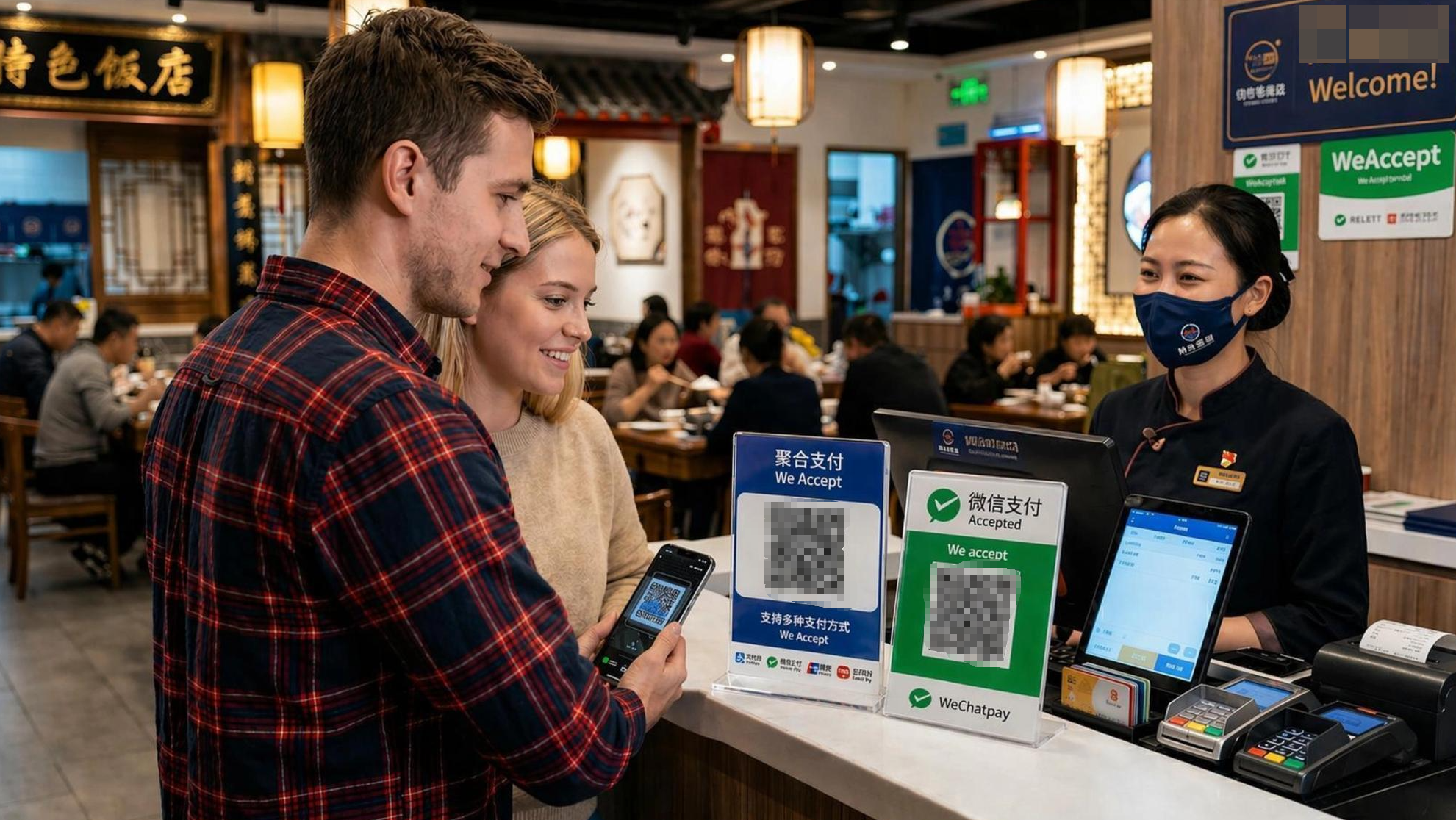
How to Pay in China as a Tourist: Alipay, WeChat Pay, Foreign Cards & Cash (2026 Guide)
Visitors to China can pay using Alipay, WeChat Pay, supported international bank cards, and Chinese yuan (RMB) cash. For a first trip, my recommendation is simple: set up Alipay with your own Visa or Mastercard before you leave home, prepare WeChat Pay as a backup, and keep about ¥300–500 in cash for emergencies.
You usually do not need a Chinese bank account or a Chinese phone number for a short holiday. But everyday payments can feel surprisingly different from what you’re used to in the United States or Europe.
In China, someone buying bottled water, noodles, a metro ticket, or fruit from a street stall may simply take out their phone and scan a QR code. Cash is still legal and useful, and physical cards haven’t disappeared, but mobile payments are woven into everyday life.
From a local Chinese perspective, learning the basics of QR-code payments before your flight is one of the most useful things you can do. This guide explains how to link an overseas card, how to scan and pay, what fees to expect, where Visa and Mastercard work, and what to do when a payment fails.
1. What Payment Methods Can Tourists Use in China?
My preferred setup is Alipay for everyday purchases, WeChat Pay as backup, a physical international card for merchants that accept it, and a little RMB cash just in case.
| Payment method | Best for | My recommendation |
|---|---|---|
| Alipay (支付宝) | Restaurants, convenience stores, shopping, transport, some attractions | Prepare before arrival |
| WeChat Pay (微信支付) | Restaurants, neighborhood shops, supermarkets, everyday purchases | Excellent backup |
| Visa, Mastercard and other international cards | Hotels, larger malls, major restaurants and merchants with suitable terminals | Keep a physical card |
| Chinese yuan cash (RMB / 人民币) | Shops, meals, emergencies and unexpected payment problems | Carry some |
| Supported overseas e-wallets | Participating merchants accepting cross-border QR payments | Check your provider |
Many businesses display both blue Alipay and green WeChat Pay signs. Imagine paying ¥18 for a bowl of noodles in Xi’an. Rather than handing over a bank card, you may scan the shop’s QR code with Alipay, enter ¥18, and confirm. At other stores, the cashier scans a payment code displayed on your phone.
It can take only seconds once you’re set up.
One important catch: being able to link an international card doesn’t mean that every QR code, person-to-person transfer, mini-program, or online service will accept that card. The difference between merchant payments and personal transfers is particularly important.

2. How to Set Up Alipay with Visa or Mastercard
Eligible overseas cards can be linked to Alipay, and many international visitors can register using a phone number from their home country.
I suggest starting with Alipay because it offers an English interface and combines payments with useful travel functions, which may include transport, ride-hailing, bookings, and other services depending on your account and location.
Step 1: Download the official app
Search for Alipay (支付宝) in Apple’s App Store or a legitimate Android app store, and install the official application. Don’t download a supposed “special China tourist version” from an unknown website or buy an account registered to someone else.
Step 2: Register with your own mobile number
Open the app, choose to sign up, select your country code, enter your number, and follow the text-message verification and security prompts. A US, UK, Canadian, Australian, or other supported overseas number can work if it passes the current registration checks.
You generally do not need a Chinese SIM card to register. If you plan to switch SIM cards in China, make sure you can still receive important verification messages on your original number, or update the account through the proper process.
Registering before you travel is easier than discovering after landing that your home number cannot receive a text.
Step 3: Add your international bank card
The menu is commonly along the lines of Me → Bank Cards → Add Card, although the wording may differ by app version.
You may be asked for your card number, expiry date, security code, cardholder details, and a verification step required by your bank. Visa and Mastercard are common starting points, but approval depends on the card scheme, issuer, individual card, and payment risk checks.
If you have a second card from another bank, bring it as a backup. This is your own foreign-issued card; it doesn’t have to be issued by a bank in China.
Step 4: Complete any identity checks
The app may ask you to verify your identity with your passport. Follow the on-screen instructions for your legal name, nationality, passport number, photo of the passport information page, and any additional checks such as face verification.
Use the same official name shown on your passport and bank records. Follow the app’s instructions for first name, family name, spacing, and special characters rather than inventing a Chinese name or using a nickname.
Step 5: Check that the card is linked
Return to the bank-card section and confirm the card appears. But don’t assume that a successfully linked card will work in every situation.
There’s no reason to transfer money to a stranger just to test it. Once in China, make a small purchase from a normal merchant—perhaps a bottle of water at a convenience store—then check the Alipay receipt and the transaction in your banking app.
3. How to Pay with Alipay QR Codes
There are two common ways to pay, and they’re worth learning before you reach the checkout.
Method A: You scan the merchant’s code
This is common at breakfast shops, small restaurants, fruit stalls, and neighborhood stores.
Imagine buying steamed buns for ¥12 in Chengdu:
- Open Alipay and tap Scan (扫一扫).
- Point your camera at the merchant’s payment QR code.
- If asked for an amount, type 12.00.
- Check the merchant’s name and amount carefully.
- Choose your linked card if necessary and confirm.
- Wait for a successful payment message, and show it to the shopkeeper if requested.
Not every code works with international cards. Some codes are personal collection or transfer codes; payments funded by overseas cards are generally intended for eligible merchant purchases rather than person-to-person transfers.
If the app says your card isn’t supported, ask whether the store has a merchant payment code or terminal that accepts international cards. Otherwise, switch to another method, such as RMB cash.
Method B: The cashier scans your code

At supermarkets, convenience stores, shopping malls, and chain restaurants, it’s common for the cashier to scan a barcode or QR code on your phone.
- Open Alipay and find Pay/Receive (收付款) or the current payment-code feature.
- Display the payment barcode or QR code.
- Let the cashier scan it with their checkout device.
- Confirm the transaction succeeded.
In this scenario, the checkout system normally enters the purchase amount, so you don’t type it yourself.
Treat your payment code as sensitive. Don’t send screenshots of live payment codes to strangers or let people outside the legitimate checkout process scan them.
Do you need to top up Alipay with yuan first?
Usually not. With an eligible international card linked, you can generally pay a participating merchant directly from the card.
For example, if you use a US-issued Visa for an ¥80 restaurant bill, the business is paid in yuan while your bank and card network handle the charge and currency conversion under their terms. You do not need to load ¥80 into your Alipay balance first.
Your actual billing currency, exchange rate, and any bank fees will appear in your card agreement and statement.
4. How to Set Up WeChat Pay as a Backup
WeChat Pay can also accept eligible overseas cards. I would set it up even if Alipay is your main payment method.
WeChat is enormously popular in China. People use it to communicate, shop, pay for meals, and sometimes order directly at a restaurant table through a mini-program.
Step 1: Install WeChat
Download the official WeChat (微信) app, then register or sign in using your own phone number. Overseas numbers are supported subject to the app’s verification process.
Step 2: Find the payment settings
The typical route is Me → Services → Wallet → Bank Cards. Depending on the account and app version, you may need to activate the wallet or finish additional setup first.
Step 3: Add a supported foreign card
Enter your card details and follow any passport or account verification instructions. Visa, Mastercard, American Express, JCB and other international schemes may be supported, depending on the card and current published list.
Step 4: Pay in a shop
The two familiar options are to scan the shop’s QR code using WeChat’s Scan feature, or display your own payment code for the cashier’s scanner. Always verify the amount and selected card.
Alipay vs. WeChat Pay: Which is better?
| Feature | Alipay | WeChat Pay |
|---|---|---|
| Registration with eligible overseas number | Yes, subject to verification | Yes, subject to verification |
| Linking supported international bank cards | Yes | Yes |
| Paying participating shops by QR code | Widely used | Widely used |
| Travel and transport services | Multiple services inside the app | Supported in selected cities and services |
| WeChat messaging and social features | No | Built into WeChat |
| Personal transfers, red packets, and balance functions with foreign cards | Restrictions apply | Restrictions apply |
For a visitor, you don’t need to declare one the winner. Set up both if you can. When one app fails, try the other—but remember that if a merchant cannot accept international-card-funded payments, both may fail for the same reason.
5. Alipay and WeChat Pay Fees for International Cards
As a general rule, a single merchant purchase of ¥200 or less using a linked foreign card is exempt from the platforms’ 3% service fee. Above ¥200, a 3% service fee may apply to the entire transaction amount, not just the portion above ¥200. Promotional waivers can change the total. Check the actual payment screen.
| Single purchase | Typical platform service fee without promotions | Calculation |
|---|---|---|
| ¥20 | ¥0 | At or below ¥200 |
| ¥100 | ¥0 | At or below ¥200 |
| ¥200 | ¥0 | At or below ¥200 |
| ¥300 | ¥9 | 3% × ¥300 |
| ¥500 | ¥15 | 3% × ¥500 |
| ¥1,000 | ¥30 | 3% × ¥1,000 |
This refers to a potential platform service charge, not all possible fees. Your home bank might separately charge foreign transaction fees or apply its own currency conversion terms.
A WeChat Pay promotion announced in 2026
According to information published by the Beijing municipal government in March 2026, eligible users who link an international card to WeChat Pay for the first time can receive a waiver of the 3% service fee on qualifying everyday transactions under ¥1,000 for 60 consecutive days beginning with their first transaction, with savings capped at ¥30 per transaction.
The regular waiver for individual transactions below ¥200 also applies to eligible international-card users. Eligibility, promotion dates, and detailed restrictions may change, so don’t assume all foreign-card transactions are permanently free.
Official references: Shanghai’s overseas-card payment guide and Beijing’s March 2026 WeChat Pay fee-waiver notice.
Should you split a large purchase into smaller payments?
I wouldn’t make that your routine strategy. Pay according to the merchant’s normal checkout process.
For an expensive hotel stay or shopping purchase, ask whether you can pay directly with your international card. That may avoid a mobile-platform surcharge, although you should still compare your issuing bank’s foreign transaction fees and exchange rates.
Are there spending limits?
Published payment-service guidance states upper limits of US$5,000 per transaction and US$50,000 a year for international-card payments linked through these services. That doesn’t mean every account starts with those limits: card issuer rules, identity checks, transaction type, and platform risk controls can impose lower limits.
Use the limit displayed in your own account as the practical reference.
6. Can You Pay Directly with Visa or Mastercard in China?
Yes, in some places—but don’t expect every business to accept your card.
Physical international cards are more likely to work at major hotels, upscale shopping malls, international retailers, larger restaurants, and selected tourist attractions. Look for the relevant acceptance logo at the counter or ask staff to check the terminal.
Networks you may encounter include Visa, Mastercard, UnionPay, American Express, JCB, and Discover, but which ones work depends on the individual merchant and payment provider.
Where is card acceptance more likely?
Larger hotels: International hotel brands are often set up for overseas cards. Ask about card acceptance if you’ll need to pay a deposit at check-in.
Shopping malls and major retailers: Some malls and brand stores can process direct international-card purchases.
Selected attractions: Tourism sites have expanded payment options, but you shouldn’t assume every small ticket kiosk accepts your particular card.
Where should you not rely on your card alone?
At a neighborhood noodle shop, breakfast stall, night market, fruit stand, or small store, QR payments may be the everyday default.
My approach: use QR payments for small daily spending, ask about direct card acceptance for larger bills, and keep cash as a fallback.
What about Apple Pay or Google Pay?
Don’t treat either as a universal solution across mainland China. Contactless payments using a foreign card in a phone wallet depend on the card network, card issuer, and merchant’s terminal.
Even if tapping your phone works everywhere at home, it may not work at the noodle shop you walk into in Xi’an. Have Alipay or WeChat Pay ready too.
7. Can You Still Use Cash in China? Can Shops Refuse RMB?
Yes, Chinese yuan cash is still legal tender. China has not abolished cash.
This matters because online discussions sometimes make it sound as though every purchase requires a smartphone. That isn’t true.
New Rules on RMB Cash Receipts, Payments and Services, effective February 1, 2026, require cash acceptance in ordinary staffed, face-to-face payment situations under the rules. Businesses generally must not arbitrarily refuse RMB cash or discriminate against cash payers; special arrangements apply to certain fully online or unattended settings.
Official legal text: China’s RMB Cash Receipts, Payments and Services rules.
Legal acceptance and everyday convenience are different things. A stall selling a ¥5 snack may be required to accept your ¥100 note but may still need extra time to find change. QR payment is often faster.
How much cash should you carry?
For a first trip, if your mobile payments are ready, I’d start with ¥300–500 in RMB. This is a practical suggestion, not an official requirement.
It can help when your phone runs out of battery, data stops working, an international card is temporarily rejected, or a payment feature doesn’t support your card.
Consider bringing more if you’re visiting remote villages or areas with unreliable connectivity. For a typical city trip through Beijing, Shanghai, Xi’an, or Chengdu, you generally don’t need to carry large amounts of cash every day.
Which denominations are useful?
Bring a mix of ¥100, ¥50, ¥20, and ¥10 notes, plus a few ¥1 and ¥5 notes or coins when available. I particularly like having smaller ¥10 and ¥20 notes for food stalls and short purchases.
Where can you get RMB cash?
- Official airport exchange counters or machines: Convenient on arrival, but rates, fees, and opening hours vary.
- Bank branches offering foreign exchange: Bring your passport and confirm they exchange your currency.
- ATMs that support your card network: Often convenient, but check the network logo and fees first.

8. How to Withdraw Yuan from an ATM with a Foreign Card
If your overseas debit card allows international withdrawals, you may be able to withdraw RMB from an ATM displaying its network logo.
For example, a visitor with a UK-issued Visa debit card can look for a Visa-supported ATM in a Chinese city and follow its available English instructions.

A typical process is:
- Find a bank-operated ATM or other reputable machine.
- Check for your card network’s logo, such as Visa or Mastercard.
- Insert your card or follow the terminal’s instructions.
- Select English if offered.
- Enter your card PIN.
- Choose Cash Withdrawal.
- Enter the amount in RMB.
- Review any displayed fees and currency conversion options.
- Complete the withdrawal, collect your money, and retrieve your card.
Not every ATM will work with every foreign card. The issuer may block international ATM usage, the card type may be unsupported, or a machine may be temporarily unavailable.
Fees may apply. These can include ATM operator fees, the issuing bank’s withdrawal fee, and exchange-rate costs. Some ATMs may offer their own currency conversion. Compare it with your bank’s terms rather than agreeing automatically.
Some machines also limit the amount you can withdraw in one transaction. Avoid making repeated fee-bearing attempts without checking the limits.
9. How Should You Pay in Different Travel Situations?
Here’s the practical decision table I’d use for everyday life in China.
| Situation | Best first option | Backup |
|---|---|---|
| Breakfast stall or noodle shop | Alipay or WeChat Pay | RMB cash |
| Supermarket or convenience store | Alipay or WeChat Pay | Cash or card if accepted |
| Hotel | Supported card or booking-platform payment | Alipay, WeChat Pay, cash as accepted |
| Metro | Valid local ride QR code or transport ticket | Single-journey ticket or transit card |
| Taxi | Alipay or WeChat Pay | RMB cash |
| DiDi or another ride-hailing app | Payment method supported inside the app | Another configured method |
| Tourist attraction | Official booking site or ticket platform | Official ticket counter where available |
| High-speed rail | Official 12306 or another legitimate booking platform | Station ticket window |
| Large shopping mall | Direct international card where accepted | Alipay or WeChat Pay |
| Small street shop | Eligible merchant QR payment | RMB cash |
Paying for the metro

Major Chinese metro systems often offer QR-code travel passes, transit cards, and single-journey tickets.
In some cities, Alipay has a path similar to Transport → Select City → Activate Transit Service. Follow the city’s current instructions to enable the ride code.
An overseas card working for shopping doesn’t guarantee that a local metro QR travel pass will support the same card. Transit products use separate agreements and eligibility rules.
If the QR ride code doesn’t work, ask metro staff how to buy a single-journey ticket or whether the system accepts a suitable bank card directly. Some Beijing metro services accept eligible overseas cards with contactless entry, but don’t assume that rule applies nationwide.
Paying for a taxi
Many taxi drivers accept Alipay and WeChat Pay. When you arrive, ask the driver for the correct payment code and pay the metered fare.
Some taxis may accept cards too. If mobile payment fails, ask to pay in RMB cash. Use licensed taxis and the standard fare process rather than informal cash arrangements with strangers.
Paying for DiDi and other ride-hailing services
Ride-hailing payment usually happens inside the app. If you’re using DiDi (滴滴) or the ride-booking service inside Alipay, make sure your selected payment method is supported before you need a ride.
Not every account with an international card linked can necessarily pay for every in-app service. Don’t leave your first ride-hailing payment setup until you’re at an airport at midnight with a nearly empty phone battery.
Paying for attraction tickets
Many popular sights use advance online booking, sometimes requiring passport details. The Terracotta Army in Xi’an and major attractions in Beijing are good examples.
Use the attraction’s official booking channel where possible and follow its actual payment options. Some Chinese mini-programs don’t support every foreign card, even if the same card works in a shop.
For example, if you’re heading to Xi’an, read our Terracotta Army ticket, passport booking and transport guide before planning your visit.
If online payment fails, check for an official international-visitor booking channel or a legitimate ticket counter rather than paying an unknown social-media seller.
Paying for a high-speed train
Use China Railway 12306 or another reputable booking platform and confirm that the ticket has actually been issued. Where relevant, station ticket windows offer another official route.
This is not the same as paying a shopkeeper through a personal QR code. Follow the rail booking system’s accepted payment methods.
10. What to Do If Alipay or WeChat Pay Doesn’t Work
Even well-prepared travelers run into occasional payment problems. Here are six common situations and what I’d try first.
Problem 1: Your international card won’t link
Possible reasons include an unsupported card type, rejection by your issuing bank, cross-border online payments being disabled, or mismatched identity details.
Check the card number, expiry date, and legal name, then contact your bank if needed. A different eligible card from another bank may work. Avoid repeatedly registering accounts with inconsistent information.
Problem 2: The card linked successfully, but a payment fails
The merchant’s code may not accept international-card-funded payments—especially if it’s a personal transfer code or a service with special restrictions.
Ask for an eligible merchant payment method or card terminal. If that’s not available, use another legitimate method such as cash. Don’t keep sending attempts to a stranger’s personal account.
Problem 3: The app requests more identity verification
The platform may require extra passport-based identity checks or risk screening. Follow the prompts inside the official application or contact its verified customer support.
Share passport photos only through trusted official channels.
Problem 4: You can’t receive a verification text
Your overseas SIM might not be roaming correctly, your bank’s verification service may be inaccessible, or SMS delivery may be delayed.
Before leaving home, check that you can receive authentication messages in China and sign in to your bank’s app. Don’t casually cancel the phone number linked to your payment accounts while traveling.
Problem 5: Your phone is offline or out of battery
Without a working phone and connection, QR payments may fail.
Set up a suitable mobile-data service, carry a power bank that complies with your airline and train rules, and keep a little cash on you. This is exactly why I’d never travel with only one payment method.
Problem 6: The name on the payment page looks unfamiliar
Stop and check the merchant and amount before approving the transaction.
Some legitimate shops use a registered business name that’s different from the storefront sign, but if you can’t verify the recipient, ask staff for an explanation.
Never approve a payment simply because someone is rushing you.
11. Five Payment Mistakes and Scams to Avoid
1. Buying someone else’s Alipay or WeChat account
Use your own phone number and real identity details. An account registered to somebody else may create problems with recovery, identity checks, security, and access to funds. Tourists don’t need to buy an account just to use mobile payments.
2. Sending large amounts to an unrelated personal QR code
For hotels, attraction tickets, tours, and other expensive services, use the business’s official payment process. Be careful if someone suddenly asks you to transfer a large sum to an unrelated individual account.
Confirm the price, merchant, and order details first.
3. Checking the RMB price but ignoring your home-currency statement
A merchant charges in yuan, but the final amount on your statement could be in dollars, euros, pounds, or another currency. It depends on the conversion rate, processing date, and your card issuer’s policies.
For larger payments, check the actual posted amount afterward.
4. Assuming every hotel can charge a foreign card
A hotel being able to register a foreign guest doesn’t mean it can accept every international card. Check accepted payment methods when booking, particularly if a deposit is due on arrival.
If your card is unsupported, ask whether the hotel accepts Alipay, WeChat Pay, or cash.
If you’re visiting Xi’an and choosing accommodation, our Bell Tower vs. Yongning Gate vs. Giant Wild Goose Pagoda hotel-area guide covers practical booking details for international travelers.
5. Sharing verification codes or card security details
Never give a stranger your SMS code, card security code, login password, or active payment code. A legitimate cashier doesn’t need your account password to take payment.
If someone claiming to be customer support contacts you unexpectedly, verify the request through the official app instead of responding to their message.
12. Payment Checklist Before Your Trip to China
If you’re planning a seven-to-fourteen-day holiday, here’s what I’d check before departure.
| Item | What to prepare |
|---|---|
| Alipay | Register and try linking an eligible international card |
| WeChat Pay | Register and prepare a second payment option |
| Bank cards | At least one suitable card, ideally a backup from another issuer |
| Bank verification | Confirm access to SMS or your banking app abroad |
| Mobile data | Arrange connectivity suitable for China |
| RMB cash | Consider ¥300–500 as an emergency reserve |
| Passport | Keep details accurate for any required identity checks |
| Bank support | Save the number to block a lost card or request assistance |
| Payment security | Enable transaction alerts, phone lock, and payment verification |
Do you need to exchange a large amount of cash beforehand?
Usually not if your mobile-payment setup is working. But a small cash reserve is sensible, and you may also be able to withdraw RMB from a supported ATM or use a legitimate currency exchange counter after arrival.
Do you need a Chinese bank account?
Usually not for a one- or two-week visit. Eligible international cards can fund Alipay or WeChat Pay merchant purchases. Long-term residents, students, or employees may have different banking needs.
Do you need special access to the international internet for payments?
You mainly need a working connection to the relevant payment services. You do not need to install an unusual network tool just to make standard Alipay or WeChat Pay payments.
However, if payment verification depends on an overseas banking app, check before departure whether that app and its authentication method will work while you’re traveling.
13. Frequently Asked Questions About Paying in China
Can I visit China with only a Visa credit card and no Alipay?
You can, but it may be inconvenient. International cards work at some hotels and larger retailers, while many small businesses do not have suitable terminals. If you don’t want to install payment apps, carry RMB cash and confirm payment options before buying.
Do I need a Chinese phone number for Alipay or WeChat Pay?
Generally no. Both can accept eligible overseas mobile numbers, subject to verification requirements.
Can I send money to a Chinese friend or send a WeChat red packet from my foreign card?
Not usually with only a linked international card. Overseas-card linking is mainly designed for eligible merchant payments; peer-to-peer transfers, red packets, and wallet balance top-ups are different features with additional restrictions.
Do shops have to accept cash?
In ordinary staffed, face-to-face transactions covered by the 2026 rules, businesses generally must accept RMB cash. Certain unattended and fully online services have different arrangements, so some bookings may still require a particular online payment method.
Do I need to exchange dollars into yuan before paying with Alipay?
Not usually. If your eligible overseas card is linked and the merchant supports that form of payment, the card transaction can settle without first topping up an RMB wallet balance. Your card network and issuer handle the currency conversion under their terms.
Is Alipay or WeChat Pay better for a first-time visitor?
If you only install one, I’d start with Alipay because its English interface and travel-related services can be convenient. But preparing both gives you a practical backup.
Final Thoughts: Make Paying in China Easy, Not Complicated
On your first trip to China, you may notice that locals rarely reach for cash—even for a small snack, a metro ride, or a bowl of noodles. QR-code payments are part of daily life from Beijing to Chengdu to Xi’an.
You don’t have to change every habit you have at home. Set up Alipay and WeChat Pay with cards you own, ask about direct card payment for bigger bills, and always carry a little RMB cash.
That way, you’re less likely to miss out on fresh roujiamo in an old Xi’an street or a spontaneous meal in Chengdu simply because the payment process feels unfamiliar.
If Xi’an is on your itinerary, see our guide to 12 local foods worth trying in Xi’an. And if you’re still deciding how long to stay, our 2-, 3- and 4-day Xi’an itineraries can help you plan around meals and sightseeing.
The goal isn’t to master every Chinese financial app. It’s to be able to pay simply, safely, and confidently while enjoying your trip.
Updated October 2026. Card eligibility, in-app menus, fees, promotional waivers, payment limits, and local transport arrangements can change. Always check the current payment screen and official provider instructions before confirming a transaction.





One Comment