How to Order Food in China as a Tourist: QR Menus, Chinese Dishes, Payments & Dining Tips
You can order food in Chinese restaurants even if you don’t speak a word of Mandarin. Many restaurants let you scan a QR code, choose dishes from photos, or order directly from a cashier or server. Alipay and WeChat Pay are widely used, some larger restaurants accept international cards, and renminbi (RMB) cash remains a valid payment option. Before you order, check the prices, ingredients, portion sizes, and payment method.

China is an extraordinary place to eat. From Peking duck in Beijing and roujiamo in Xi’an to spicy Sichuan hotpot and Shanghai soup dumplings, every region has its own specialties.
But your first visit to a local Chinese restaurant can feel unfamiliar. Why is there a QR code on the table instead of a paper menu? Why hasn’t anyone come over to take your order? And why is everyone sharing dishes?
Here’s what I’d explain to a friend visiting China for the first time. Once you know a handful of habits, ordering at a Chinese restaurant is much easier than it looks—even without speaking Chinese.
1. How Do You Order Food at a Restaurant in China?
The three most common methods are QR-code ordering, ordering at the counter, and ordering with a waiter. Which one you encounter depends on the restaurant.
| Restaurant type | Common ordering method |
|---|---|
| Chain restaurants and shopping-mall restaurants | QR menu or table service |
| Local noodle shops and breakfast places | Counter ordering or speaking to staff |
| Traditional sit-down Chinese restaurants | Waiter or QR menu |
| Hotpot restaurants | QR menu for broth, meat, vegetables and sauces |
| Street-food stalls | Pointing at food or ordering from a displayed menu |
If nobody brings you a menu after you sit down, that doesn’t necessarily mean you’re being ignored. Look for a small sign or sticker with a QR code on the table.
My local tip: Check the table first. If you don’t see a QR code—or you’d rather not use it—ask for a menu or for someone to help you order.
2. How to Order with a QR Code in China: Step by Step
QR ordering is very common in Chinese restaurants, but it isn’t quite the same as QR payment.
A QR menu opens the restaurant’s digital ordering system so you can choose dishes and submit your order. A payment QR code is used to pay. Sometimes both steps happen in the same mini-app, but don’t assume they do.

Example of a restaurant table QR ordering sign photographed in Hong Kong. Mainland Chinese restaurants use similar systems, although the screens and apps vary.
Step 1: Find the QR code on your table
Look for a tabletop sign, sticker, or printed card saying 扫码点餐 (scan to order). Many also show a table number such as 08桌 (Table 08).
That number matters: it tells the kitchen where to deliver your food.
Step 2: Scan with WeChat or Alipay
Open WeChat (微信) or Alipay (支付宝) and choose Scan / 扫一扫.
Some restaurants use WeChat mini-programs, while others accept Alipay or open a normal web menu. If Alipay doesn’t open the menu, try WeChat.
Scan only a legitimate restaurant code. You should never need to share your banking password, one-time verification code, or payment PIN with restaurant staff.
Step 3: Read the digital menu
You’ll typically see pictures, Chinese dish names, prices, and buttons to change quantities. Some menus offer English, but smaller local restaurants may not.
Use your phone’s camera-translation feature to get a basic idea of the dishes. If you have allergies or religious dietary restrictions, confirm the ingredients with a person rather than relying only on machine translation.
Step 4: Choose dishes and quantities
Tap the + button beside what you want. For example:
- 宫保鸡丁 × 1 — one portion of Kung Pao chicken
- 米饭 × 2 — two portions of rice
Remember that many Chinese dishes are intended to be shared. One dish doesn’t always mean one person’s meal.
For two adults, starting with two shared dishes and two bowls of rice is often sensible. You can order more later if you’re still hungry.
Step 5: Check the cart and submit
Common Chinese buttons include:
| Chinese button | Meaning |
|---|---|
| 去结算 | Proceed to checkout |
| 提交订单 | Submit order |
| 确认下单 | Confirm order |
| 立即支付 | Pay now |
Check your items, quantities, table number, and total before confirming.
Some restaurants require payment before cooking; others let you pay at the end. Make sure the screen actually confirms that your order has been accepted. A filled shopping cart alone is not an order.
Step 6: Wait for your food
The kitchen normally sends the food to the table number in your order. If you’ve waited a long time, show a staff member your order screen and ask:
请问我的菜做好了吗? — Is my food ready yet?
If the mini-program doesn’t work or asks for a Chinese phone number you don’t have, ask a staff member for another way to order. You shouldn’t feel obliged to register for an unrelated account just to have lunch. Consumer advocates in China have criticized mandatory QR-only ordering without reasonable alternatives.
If your phone doesn’t have working mobile data yet, see our guide to getting internet in China with an eSIM, SIM card, or roaming before your trip.
3. How to Read a Chinese Menu Without Speaking Chinese
Chinese dish names are not always literal descriptions of ingredients. 鱼香肉丝 (fish-fragrant shredded pork), for example, traditionally contains pork rather than fish. And 老婆饼 (wife cake) is a pastry—not a description of its ingredients!
Instead of trying to translate every character, start with common food words.
| Chinese | English |
|---|---|
| 招牌菜 | Signature dish |
| 推荐 | Recommended |
| 主食 | Staple food / main starch |
| 米饭 | Rice |
| 面条 | Noodles |
| 猪肉 | Pork |
| 牛肉 | Beef |
| 羊肉 | Lamb / mutton |
| 鸡肉 | Chicken |
| 海鲜 | Seafood |
| 素菜 | Vegetable dish (confirm ingredients) |
| 不辣 | Not spicy |
| 微辣 | Mild spice |
| 特辣 | Very spicy |
These words are a starting point, not an ingredient guarantee. A vegetable dish may contain animal stock or cooking fat, while a dish marked “not spicy” can still contain seasonings you’re unfamiliar with.
Three tricks that actually help
Choose dishes with photos. Pictures reveal the general style and sometimes the portion size, although you should still ask about ingredients.
Use camera translation. Download your preferred translation app and its Chinese offline language data before traveling, if available.
Show the staff a photo of what you want. This works particularly well for famous dishes. Just remember that a picture found online doesn’t guarantee the restaurant makes the same recipe.
4. What Should You Order at a Chinese Restaurant for the First Time?
If you’re new to regional Chinese food, start with a few recognizable dishes, then get more adventurous.

Peking duck with accompaniments—one of the most famous dishes to try in Beijing.
| Dish | What to expect |
|---|---|
| Peking duck (北京烤鸭) | Roast duck served with thin pancakes, scallions and sauce |
| Xi’an roujiamo (西安肉夹馍) | Flatbread stuffed with braised meat |
| Shanghai xiaolongbao (上海小笼包) | Delicate soup-filled steamed dumplings |
| Sichuan mapo tofu (四川麻婆豆腐) | Tofu in a spicy, numbing sauce, often with minced meat |
| Kung Pao chicken (宫保鸡丁) | Chicken stir-fried with chilies and peanuts |
| Yangzhou fried rice (扬州炒饭) | Rice with egg, vegetables and other ingredients |
| Lanzhou beef noodles (兰州牛肉面) | Hand-pulled noodles in beef broth |
| Chengdu hotpot (成都火锅) | Meat and vegetables cooked at the table in a shared broth |

Roujiamo is a classic Shaanxi street-food specialty, especially associated with Xi’an.

Xiaolongbao contain hot soup inside—take a small bite before eating the whole dumpling.
Of course, recipes vary. Some dishes contain pork, peanuts, sesame, wheat, eggs, seafood, or other allergens, even when that isn’t obvious from the English name.
China’s regional flavors also differ enormously. Sichuan and Chongqing are known for spicy and numbing dishes; Cantonese cooking often emphasizes the ingredients’ natural flavor; and Shaanxi has a rich tradition of wheat noodles and flatbreads.
If Xi’an is on your itinerary, our local guide to 12 must-try foods in Xi’an is a useful next read, with dish names and dining suggestions.
My advice: Don’t limit yourself to the versions of Chinese food that are popular at home. Eating what people actually enjoy in each city is part of the travel experience.
5. Do You Order One Dish Per Person in China?
Not necessarily. Shared dishes are a normal part of dining at many traditional Chinese restaurants.
For example, two people could order one plate of Kung Pao chicken, one plate of stir-fried greens, and two bowls of rice. Everyone takes food from the shared dishes.

Kung Pao chicken is often served as a shared dish, not necessarily as an individual main course.
For a group of four, add more dishes according to appetite. Restaurant portions vary, so start reasonably and order extra if necessary.
Is rice included?
Don’t assume so. Rice is often ordered and charged separately.
Ask: 这个菜带米饭吗? — Does this dish come with rice?
Hotpot ingredients and barbecue skewers are often priced per portion or item. Live fish and seafood may be priced by weight.
A particularly useful term is 斤 (jin), a Chinese unit equal to 500 grams. At seafood restaurants, check whether the listed price is per dish, per jin, or another unit—and whether cooking fees are extra.
6. How Do Tourists Pay at Restaurants in China?
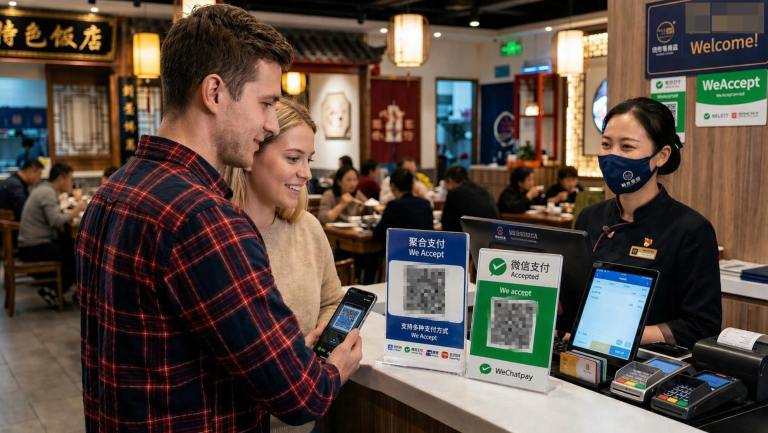
Chinese restaurants commonly accept Alipay, WeChat Pay, RMB cash, and, at some establishments, bank cards.
For most first-time travelers, I’d prepare both Alipay and WeChat Pay and try linking an eligible international bank card in advance.

An everyday QR-payment scene at a restaurant in Beijing. In some stores, the cashier scans the customer’s payment code.
Alipay and WeChat Pay
You may scan the restaurant’s merchant payment code, or show a payment code from your phone for a cashier to scan.
International cards such as eligible Visa and Mastercard cards can be linked for supported merchant purchases. However, some personal QR codes, mini-programs, and other transaction types don’t accept payments funded by foreign bank cards.
If it fails, ask whether the restaurant has another merchant payment method or accepts cash.
Government payment guidance generally says that transactions of ¥200 or less on eligible overseas cards linked to Alipay or WeChat Pay are exempt from the platforms’ 3% service fee, while larger payments may be charged 3% of the full amount. Promotional discounts and your own bank’s foreign-transaction fees can change the final cost; always check the payment screen.
International bank cards
Some large restaurants, international hotels, and shopping-mall restaurants accept international Visa or Mastercard payments directly. Small noodle shops and street stalls may not have compatible card terminals.
RMB cash
Cash is still legal and usable in China. Rules that took effect on February 1, 2026 require support for RMB cash in applicable in-person, staffed-payment situations, with different arrangements for fully online or unattended services.
A few ¥10, ¥20 and ¥50 notes are handy for emergencies.
For setup instructions, overseas-card limitations, fees, and cash advice, read our complete Alipay, WeChat Pay, and cash guide for travelers.
7. How Much Does It Cost to Eat Out in China?
Restaurant prices vary by city, neighborhood, and type of restaurant. Use these as rough trip-planning estimates, not fixed nationwide prices.
| Meal type | Estimated cost per person |
|---|---|
| Breakfast stall | ¥10–20 |
| Noodle shop or small snack restaurant | ¥15–35 |
| Casual sit-down Chinese restaurant | ¥40–80 |
| Hotpot or barbecue | ¥60–120 |
| Upscale restaurant | ¥150+ |
If you’re eating mostly at ordinary local places, around ¥80–150 per day is a sensible initial food allowance. Popular tourist districts and upscale restaurants in Beijing or Shanghai can cost more.
Do you tip in China?
Usually not. Tipping isn’t expected in ordinary restaurants. Pay the amount on the bill. Some upscale hotel restaurants may add a disclosed service charge, so check the menu before ordering.
8. Six Dining Mistakes to Avoid
Mistake 1: Ordering without checking the price
Be particularly careful with live seafood, whole fish, and ingredients sold by weight. ¥38 per jin is not the same as ¥38 for the entire dish. Confirm the estimated total and any preparation charges first.
Mistake 2: Ordering far more food than you can eat
Many Chinese dishes are made for sharing. If there are only two of you, start with two or three dishes rather than ordering a full main course for each person.
Mistake 3: Overlooking tableware and tea charges
Some restaurants may charge separately for packaged tableware, tea, or a table setting. Tea charges are particularly relevant in some Cantonese dining settings. Fees should be clearly disclosed, so ask before ordering if you’re unsure.
Mistake 4: Forgetting to check the spice level
Chinese food isn’t universally spicy, but certain dishes from Sichuan or Chongqing can be hotter—or more numbing—than you expect.
Say 不要辣椒 (no chili peppers) or 不要花椒 (no Sichuan peppercorns) if needed. Sauces prepared in advance may not be adjustable.
Mistake 5: Relying entirely on machine translation for allergies
A vegetable dish may include meat broth, dried shrimp, peanut oil, or other ingredients you can’t see. With a serious allergy, have staff confirm ingredients and cross-contact risks with the kitchen. If they can’t confirm, don’t take the risk.
Mistake 6: Confusing order confirmation with payment
Some places are pay-before-eating; others bring the bill afterward. Check whether you’ve actually paid, and keep the receipt or payment record to avoid duplicate charges.
If a price looks wrong, ask for an itemized bill and retain the menu and order details.
9. Vegetarian, Halal, or Food Allergies? What to Say
If you have dietary restrictions, show the staff a clear written Chinese explanation before ordering.
| Show this Chinese sentence | English meaning |
|---|---|
| 我吃素,不吃肉和鱼。 | I’m vegetarian. I don’t eat meat or fish. |
| 不要肉汤。 | No meat broth, please. |
| 不要猪肉。 | No pork, please. |
| 我需要清真食品。 | I need halal food. |
| 我对花生过敏。 | I’m allergic to peanuts. |
| 我对海鲜过敏。 | I’m allergic to seafood. |
| 请帮我确认食材。 | Please check the ingredients. |
| 我不能吃辣。 | I can’t eat spicy food. |
Some otherwise vegetable-focused dishes are seasoned with lard, meat stock, or dried shrimp. If you’re strictly vegan, also check for eggs, dairy, fish sauce, and other animal-derived ingredients.
If you require halal food, look for restaurants displaying 清真 (qingzhen / halal), and verify preparation standards when your requirements are strict.
For severe allergies, carry a detailed Chinese-language allergy card that includes sauces, cooking oils, and the risk of cross-contact from shared utensils and cooking equipment. Neither translation apps nor a casual verbal assurance can guarantee an allergen-free kitchen.
10. Useful Chinese Phrases for Ordering Food
Save this table on your phone. You don’t need to pronounce everything correctly—showing the Chinese text often works just as well.
| Chinese | English |
|---|---|
| 请给我菜单。 | Could I have the menu? |
| 有英文菜单吗? | Do you have an English menu? |
| 我要这个。 | I’d like this one. |
| 这个是什么肉? | What kind of meat is this? |
| 这个辣吗? | Is this spicy? |
| 请给我一份米饭。 | One serving of rice, please. |
| 可以给我一个勺子吗? | Could I have a spoon? |
| 请问怎么付款? | How can I pay? |
| 买单,谢谢。 | The bill, please. |
| 可以打包吗? | Can I get this to go? |
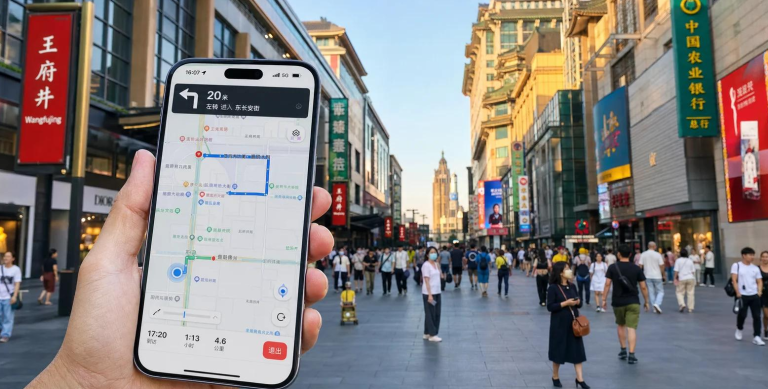
If you’re trying to find a restaurant in the first place, search its Chinese name using Amap. Our guide to Amap, Apple Maps, Baidu Maps, and Google Maps in China explains how to find local businesses and navigate Chinese addresses.
Final Thoughts: Eating in China Without Speaking Chinese
You don’t need to speak Mandarin to enjoy China’s food scene.
Learn how to scan a restaurant QR menu, recognize a few common food words, check your bill, and prepare a reliable way to pay. Those simple skills are enough for many everyday meals.
My favorite advice for your first restaurant visit is to keep the order simple: try one local specialty and a staple such as rice or noodles. Once you’re comfortable with the routine, explore more regional dishes.
The most memorable part of traveling in China isn’t only seeing the Great Wall, the Forbidden City, or the Terracotta Army. It’s also discovering a tiny breakfast shop, a neighborhood noodle restaurant, or a lively family-run dining room where locals come back every day.
I hope you’ll leave with more than familiar takeout-style Chinese food—and discover the flavors people here actually eat.
Updated October 2026. Ordering methods, menu prices, payment features, and ingredients vary by restaurant. Check the actual menu and confirm dietary needs with staff before ordering.